Every July, the disability community marks Disability Pride Month: an annual celebration tied to the signing of the Americans with Disabilities Act (ADA) on July 26, 1990. The ADA was a landmark civil rights law that prohibited discrimination against disabled people in employment, public accommodations, transportation, and government services. It was the result of decades of organizing, protest, and sacrifice by disabled people who refused to be invisible.
Disability Pride is a framework, a pushback against the shame and stigma that society has historically attached to disabled people. It’s the insistence that disability is not a tragedy to be overcome or erased, but a natural part of human variation that deserves to be celebrated, accommodated, and centered. 1 in 4 adults in the U.S. has a disability. The CDC estimates that the majority of people will experience disability at some point in their lives. This is a human topic and not exclusive to currently disabled people, and the shame around it actively blocks access, innovation, and community.
The World Works Better With Us
This year’s Disability Pride Month theme, The World Works Better With Us, was selected by The Arc’s National Council of Self-Advocates (NCSA), a disabled-led advisory body.
Not “with accommodations, if it’s not too much trouble.” Not “as long as you can keep up.” But with us, being accepted on our own terms. When disabled people are included, respected, and actually supported in schools, workplaces, healthcare, transportation, and public life, communities function better for everyone.
Accessibility design and accommodations benefit everyone, even those that are not disabled. Think about curb cuts, the sloped sections of sidewalk at street crossings. Originally designed so wheelchair users could navigate sidewalks, they are now used by people pushing strollers, delivery workers with hand trucks, cyclists, and anyone carrying something heavy. Closed captioning was built for Deaf viewers, but is now used by people watching content in noisy spaces, learning English, or who forgot their headphones. It has also influenced audiobooks and voice dictation. While these and other accommodations started as access tools, they have become infrastructure everyone relies on.
Disability drives innovation. The “curb cut effect” is a prime example of how access for the most marginalized raises the floor for everyone. The world works better with us in it.
The Disability Pride Flag

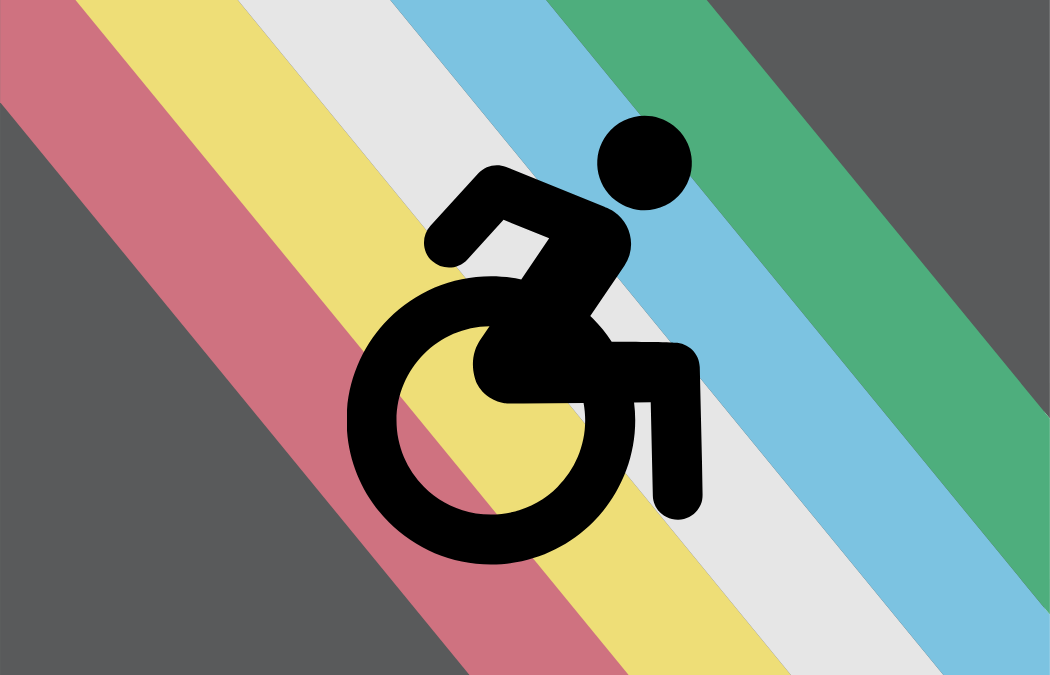
The Disability Pride flag was originally designed by Ann Magill in 2019 and later updated in 2021 to improve accessibility. The diagonal stripes on a charcoal background each carry meaning and together they represent the full breadth of the disability community.
- Faded black – mourning and rage for disabled people who are victims of ableism, abuse, eugenics, and medical neglect, and a protest against those ongoing systems.
- Red – represents physical disabilities.
- Gold – for neurodiversity.
- White – for invisible and undiagnosed disabilities.
- Blue – stands for emotional and psychiatric disabilities.
- Green – for sensory disabilities (deafness, blindness, lack of smell or taste, and all other sensory disabilities).
The diagonal placement of the stripes (that used to be zigzag but was refined after feedback from the community) represents disabled people “cutting across” society and refusing to be pushed to the margins. The updated version also uses muted tones specifically to be more accessible to people with visual and light sensitivities.
How We Got Here and Who Built This Movement
Disability Pride Month has its roots in Boston, Massachusetts, where the first Disability Pride Day was celebrated in 1990, the same year the ADA was signed. But the road to the ADA was paved by decades of activism that is still dramatically underrepresented in mainstream history education.
The Independent Living Movement
The concept of disabled people living independently, directing their own care, and participating fully in their communities didn’t just appear. It was built by activists like Ed Roberts, a quadriplegic man who became one of the first disabled students admitted to UC Berkeley, and who went on to co-found the Independent Living Movement. The Center for Independent Living in Berkeley, founded in 1972, became the model for hundreds of centers across the country. The movement insisted on a simple but radical idea: disabled people should control their own lives, not institutions, not medical professionals, but disabled people themselves. This began in the 1970s, yet in the current day, we are still facing threats to overturn important civil rights protections for disabled people’s right to independent and community living.
Section 504 and the First Sit-In (1977)
Before the ADA, there was Section 504 of the Rehabilitation Act of 1973: a provision that prohibited discrimination against disabled people by any program receiving federal funding. However, the government refused to enforce it. So in 1977, disability rights activists organized what became the longest sit-in at a federal building in U.S. history. In San Francisco, activists occupied the Department of Health, Education, and Welfare offices for 28 days until regulations were finally signed.
The Capitol Crawl (1990)
In March 1990, approximately 1,000 disability rights activists descended on the U.S. Capitol in Washington, D.C. to demand the passage of the ADA. In one of the most powerful moments of the entire disability rights movement, dozens of activists abandoned their wheelchairs and mobility aids and physically crawled up the 83 marble steps of the Capitol building. Eight-year-old Jennifer Keelan famously pulled herself up those steps, a moment that was photographed and broadcast nationally. Four months later, the ADA was signed into law.
The People Mainstream History Leaves Out
Disability justice – not just disability rights, but disability justice – was built by BIPOC disabled activists. The mainstream disability rights movement of the 1970s–90s was predominantly white and often centered on a fairly narrow vision of independence and legal access. Disability justice expanded that vision to include intersectionality, community care, and the recognition that ableism doesn’t exist in isolation from racism, poverty, and all the other systems of oppression.
Sins Invalid, a disability justice performance project founded in 2005 by Patricia Berne and Leroy Moore, was central to articulating the 10 Principles of Disability Justice: a framework that centers intersectionality and insists that any liberation movement that doesn’t account for disability is incomplete. Berne, Moore, and those who came after them named the gaps the mainstream disability rights movement couldn’t see.
Why Have Disabled Pride at All?
Disability Pride Month matters right now. While the historical landmarks discussed have advanced the rights for disabled people, we still face harmful barriers to access and justice. The disability community has recently faced threats to civil rights such as independent and community living, rollback of integration that prohibits unnecessary institutionalization, reduction of access to necessary medical supplies, care, and benefits, educational accommodations in public schools, and more.
What About the “Pride” Part?
I know “pride” is a loaded word. For many, pride is not the first thing we feel. Grief, frustration, exhaustion tend to come first after facing years of unanswered questions, barriers, unmet accessibility needs, and more. But what I’ve come to understand is that shame keeps us isolated. Shame keeps us from advocating. Shame keeps us small and quiet and separated from each other.
Pride is the acknowledgment that we exist, that our lives have value, and that the barriers we face are not our fault. By showing pride in who you are as a person with a disability, you break down stigmas and barriers to access and influence the next generations to do the same.
How Can You Actually Celebrate?
Whether you’re disabled, a caregiver, an ally, or still figuring out where you land, there are many ways to celebrate.
- Attend a Disability Pride Event
Many cities host parades, panels, and community gatherings throughout July. The Arc has a roundup of how to find and celebrate events near you. - Use Affirming Language
Both identity-first (“disabled person”) and person-first (“person with a disability”) are valid and it is best to follow the lead of the individual. “Disabled” is not a bad word. - Challenge Ableism in Real Time
In the workplace, in conversations, in content you consume. Call it out, or at minimum, don’t amplify it. - Consider Intersectionality
Engage with disability content created by BIPOC, LGBTQ+, and multiply marginalized disabled people. Whose voices are you centering? Disability is not a monolith. - Connect With the Disabled Community
Spend time with those in your local community. Get to know who your neighbors are. - Write Your Representatives
The ADA is under ongoing threat. Medicaid cuts, accessibility rollbacks, and healthcare legislation directly harm disabled people. You can find your elected officials at usa.gov/elected-officials. - Read and Watch
Educating yourself is free and powerful. A few starting places below:- BOOK Disability Visibility — Ed. Alice Wong: First-person essays from disabled writers. Essential.
- BOOK Black Disability Politics — Sami Schalk: The history that mainstream disability narratives erase.
- BOOK Being Heumann — Judith Heumann: A memoir from a foundational disability rights activist.
- FILM Crip Camp: A Disability Revolution: Netflix documentary about Camp Jened and the movement that grew from it. Watch this one.
- RESOURCE 10 Principles of Disability Justice — Sins Invalid: The framework. Read it. Save it.
- PROJECT Disability Visibility Project: Alice Wong’s ongoing podcast, archive, and community hub.
Tayler Goectau, Author
Clinical Research Coordinator
Disability Advocate
@distaaybled
July , 2026