
When people think about the body systems affected by Ehlers-Danlos Syndrome (EDS), the voice box probably isn’t one of the first things that comes to mind. People with EDS often learn that connective tissue plays a role in far more parts of the body than they initially realized, and yet they may still be surprised […]
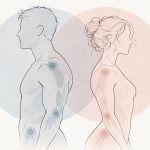
Hypermobile Ehlers-Danlos syndrome (hEDS), and the closely related hypermobility spectrum disorders (HSD), are commonly thought of as conditions that primarily affect women. Walk into any EDS support group, online community, or clinic waiting room, and the overwhelming majority of people there will be female. But does that mean men are truly less affected, or does […]

Ehlers-Danlos Syndrome (EDS) is a complex chronic condition that for many patients comes with some level of disability. It also often comes with other comorbidities (health conditions that occur alongside a primary diagnosis) such as dysautonomia or mast cell activation syndrome (MCAS). As there are 13 types of EDS and symptoms often manifest differently in […]

There’s a particular kind of exhaustion that has nothing to do with the joint pain, dysautonomia flares, or GI symptoms. It has everything to do with how you’re expected to present those things to other people, specifically your healthy, able-bodied friends or coworkers or strangers on the street. If you have Ehlers-Danlos syndrome (EDS) or […]

For most of my life, other people told my story. As a teenager, I saw my story appear in newspaper articles, documentaries, and conference presentations, focused on my rare genetic condition, scientific discovery, and perseverance. The stories helped other families find answers and gave people hope, and I remain grateful for the community they created. […]
If you have hEDS or HSD, it probably isn’t news to you that these conditions are sometimes associated with neuro-related comorbidities such as postural orthostatic tachycardia syndrome (POTS), craniocervical instability (CCI), tethered cord, and intracranial hypertension, among others. However, a new concept paper, released as a preprint on August 10, 2026, suggests that there may […]

There’s a good chance you’ve heard how important “getting stronger” is for bendy people. And it’s true: bendy people have been shown to generate about 30% less muscular force (i.e. be 30% weaker) at baseline than their non-bendy counterparts. And yet, the bendy body relies even more heavily on muscular support than others, thanks to […]

There is exciting news for the recently reported 17% of hEDS patients and 14.7% of HSD patients who experience polycystic ovary syndrome, now renamed to polyendocrine metabolic ovarian syndrome. On May 12th, 2026, a new article was published in The Lancet announcing the name change from polycystic ovary syndrome (PCOS) to polyendocrine metabolic […]

Ehlers-Danlos Syndrome May Increase Susceptibility to Infections
EDS, POTS and MCAS Linked by One Gene Mutation

Popular People With Ehlers-Danlos Syndrome

In memory of John Ferman, Founder and President of Chronic Pain Partners / EDS Awareness
EDS Physical Therapy Book & Free Webinar: “Living Life to the Fullest with Ehlers-Danlos Syndrome”