
For people living with hypermobile Ehlers-Danlos syndrome (hEDS) and related hypermobility disorders (like HSD), noticing redness in the hands or feet may not be unusual. Dysautonomia, a dysfunction of the autonomic nervous system that regulates automatic body processes like heart rate, blood pressure, and circulation, can be common in hEDS and HSD. One of its […]

When people think about the body systems affected by Ehlers-Danlos Syndrome (EDS), the voice box probably isn’t one of the first things that comes to mind. People with EDS often learn that connective tissue plays a role in far more parts of the body than they initially realized, and yet they may still be surprised […]
If you have hEDS or HSD, it probably isn’t news to you that these conditions are sometimes associated with neuro-related comorbidities such as postural orthostatic tachycardia syndrome (POTS), craniocervical instability (CCI), tethered cord, and intracranial hypertension, among others. However, a new concept paper, released as a preprint on August 10, 2026, suggests that there may […]

This month, we spoke with Amy Wang-Hiller, a violinist living with quadriplegia, hypermobile Ehlers-Danlos syndrome (hEDS), and related complex neuro-connective tissue conditions. As a violin instructor, Amy works with intermediate and advanced musicians navigating changes that affect performance, such as complex neurological disorders. She is also a disability advocate, founder of the InclusiVibe Foundation, and […]

This article explores whether upright MRI may be a useful tool for evaluating EDS-related spinal instability. Understanding the limitations of standard MRI and what positional imaging could offer instead, may help patients, clinicians, researchers, advocates, and healthcare providers better navigate the complex neurosurgical landscape of EDS. Why Supine MRI May Miss the Problem Cervical […]
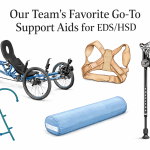
This month, we wanted to give you a peek into the daily lives of our team members by asking them to share a few of their favorite go-to supportive items for Ehlers-Danlos syndromes (EDS) or hypermobility spectrum disorders (HSD). While these aids might be what work for us personally, we hope they offer inspiration and ideas to help you live your life to the fullest with EDS/HSD.
What Two New Studies Say About the Head, Neck, and hEDS People with Ehlers-Danlos syndrome have heard for years that their symptoms are “in their head.” In one sense, that may be true—but not in the way we all hate to hear. When it comes to symptoms like headaches, nausea, dizziness, brain fog, visual disturbances, […]

Previous editions of Research Round-up can be found at the following links: Edition 5 (Pediatrics) Edition 4 (Neurodivergence) Edition 3 Edition 2 Edition 1 Howdy, partners! This Research Round-up has roped in a whole herd of topics for you. We hope you enjoy the read, learn a thing or two, and feel […]

Ehlers-Danlos Syndrome May Increase Susceptibility to Infections
EDS, POTS and MCAS Linked by One Gene Mutation

Popular People With Ehlers-Danlos Syndrome

In memory of John Ferman, Founder and President of Chronic Pain Partners / EDS Awareness
EDS Physical Therapy Book & Free Webinar: “Living Life to the Fullest with Ehlers-Danlos Syndrome”