Welcome back to Research Round-Up. This time, we’re looking at research that focuses on Ehlers-Danlos Syndrome (EDS) and Hypermobility Spectrum Disorder (HSD) in the young ‘uns, from birth to age 18. While some of the effects of EDS can be the same on adults as on the little ones, sometimes, the kiddos have more to deal with than we realize. This is a sampling of research from the past two years. Saddle up—we’re about to hit the kid-friendly trails!
CARDIOVASCULAR/AUTONOMIC NERVOUS SYSTEM
Cardiovascular, autonomic symptoms and quality of life in children with hypermobile Ehlers–Danlos syndrome
Published in Sage Open Medicine in Jun 2024 | Link to full text
Research by Amanda K. Hertel, William R. Black, Ashley Lytch, Emily Cramer, Lindsey Mallory Walton, and Jordan T. Jones
Summary: Cardiovascular and autonomic symptoms are thought to be prevalent in pediatric patients diagnosed with hypermobile Ehlers–Danlos syndrome (hEDS). This study found that a high percentage of children with hEDS experience autonomic symptoms, such as orthostatic intolerance and postural orthostatic tachycardia syndrome (PoTS), which significantly impact their quality of life. Specifically, PoTS and tachycardia (fast heart rate) had the most impact on quality of life. These symptoms are primarily related to autonomic dysfunction rather than structural heart problems, as most patients had normal echocardiogram results. The research highlights the need for clinicians to be aware of these common comorbidities in pediatric hEDS patients to ensure timely screening and treatment.
Bonus read: Learn how to distinguish POTS from anxiety—and how to talk to your doctor about it.
Hyperhidrosis and Hypermobility Spectrum Disorders Among Adolescents
Published in JAMA Dermatology on March 27, 2024 | Link to full text
Research by Yair Zloof MD, Estrela Derazne MSc, Maya Braun MD, PhD, Rivka Friedland MD, Oded Scheuerman MD, Amir Shlaifer MHA, and Lotem Goldberg MD
Summary: This paper is from a cross-sectional study exploring the link between excessive sweating (hyperhidrosis) and conditions causing joint hypermobility in Israeli adolescents during medical evaluation prior to compulsory military service between 1998 and 2020. Researchers found that teens with hyperhidrosis were almost twice as likely to also have HSD or hEDS, suggesting autonomic dysfunction and “shared mechanistic pathways” may be the shared biological cause. The study highlights the importance of clinicians considering the presence of one condition when diagnosing the other.
Longitudinal echocardiography in pediatric patients with hypermobile Ehlers-Danlos syndrome
Published in the American Journal of Medical Genetics in Dec 2024 | Link to full text
Research by Hannah Lahey, Haewon Shin, Katherine Myers, and Kim L. McBride
Summary: This research investigates the risk of aortic root dilation in pediatric patients diagnosed with hEDS. Using data from previous echocardiograms, researchers found that while some children initially showed mild aortic dilation, these measurements normalized over time in most cases. This led them to conclude that the rate of aortic dilation is likely not significantly different from the general population. Consequently, the study proposes that routine echocardiography may not be necessary for individuals with hEDS unless other heart issues are present. This may also be the rationale for removing aortic dilation from the hEDS diagnostic criteria.
Related reads: Two children’s books about accepting those who are different with a focus on EDS
DIAGNOSIS
Patient and parent knowledge, understanding, and concerns after a new diagnosis of Ehlers Danlos syndrome
Published in the Orphanet Journal of Rare Diseases on Dec 30, 2024 | Link to full text
Research by Jordan T. Jones, Lora L. Black, and William R. Black
Summary: This research investigates the knowledge, understanding, and concerns of patients and their parents shortly after a new diagnosis of EDS. It highlights that while many seek information about EDS, a significant number express a lack of knowledge and educational materials as major barriers to feeling comfortable with the diagnosis and managing symptoms. The study emphasizes the need for improved and varied educational approaches, including subtype-specific information and perhaps follow-up support, to address the concerns and enhance the understanding of families navigating a new EDS diagnosis.
Related: A discussion about being the mother of a child with EDS–ins, outs, ups, and downs, and everything in between.
Variability of joint hypermobility in children: a meta-analytic approach to set cut-off scores
Published in the European Journal of Pediatrics on May 27, 2024 | Link to full text
Research by Cylie M. Williams, James J. Welch, Mark Scheper, Louise Tofts, and Verity Pacey
Summary: This research uses a meta-analysis of data from nearly 29,000 children worldwide to propose a new, data-driven cut-off score for defining generalized joint hypermobility in children using the Beighton score. Previously, this threshold was based on expert opinion, but this study found that a score of 6 or more on the Beighton score is a more appropriate working definition. They also suggest that a score of 7 or greater might be particularly suitable for females, who tend to have greater flexibility in general. The authors hope to provide clearer clinical guidance and reduce unnecessary testing in the pediatric population.
Related: A critical look at the 2017 hEDS & HSD diagnostic criteria
Pediatric joint hypermobility: a diagnostic framework and narrative review
Published in the Orphanet Journal of Rare Diseases on May 4, 2023 | Link to full text
Research by Louise Jane Tofts, Jane Simmonds, Sarah B. Schwartz, Roberto M Richheimer, Constance O’Connor, Ellan Elias, Raoul Engelbert, Katie Cleary, Brad T. Tinkle, Antoine D. Kline, Alan J. Hakin, Marion A. J. van Rossum, and Verity Pacey
Summary: This paper presents a new diagnostic framework for pediatric joint hypermobility and related conditions, like EDS and HSD. It was developed by a working group to address the difficulty of applying adult diagnostic criteria to children and adolescents. The framework outlines four key components: generalized joint hypermobility, skin and tissue abnormalities, musculoskeletal complications, and core comorbidities. Using a higher Beighton score threshold for children (greater than or equal to 6 out of 9), it aims to better categorize the various ways joint hypermobility appears in patients. It provides a foundation for improving clinical care and research in the pediatric population before they reach biological maturity.
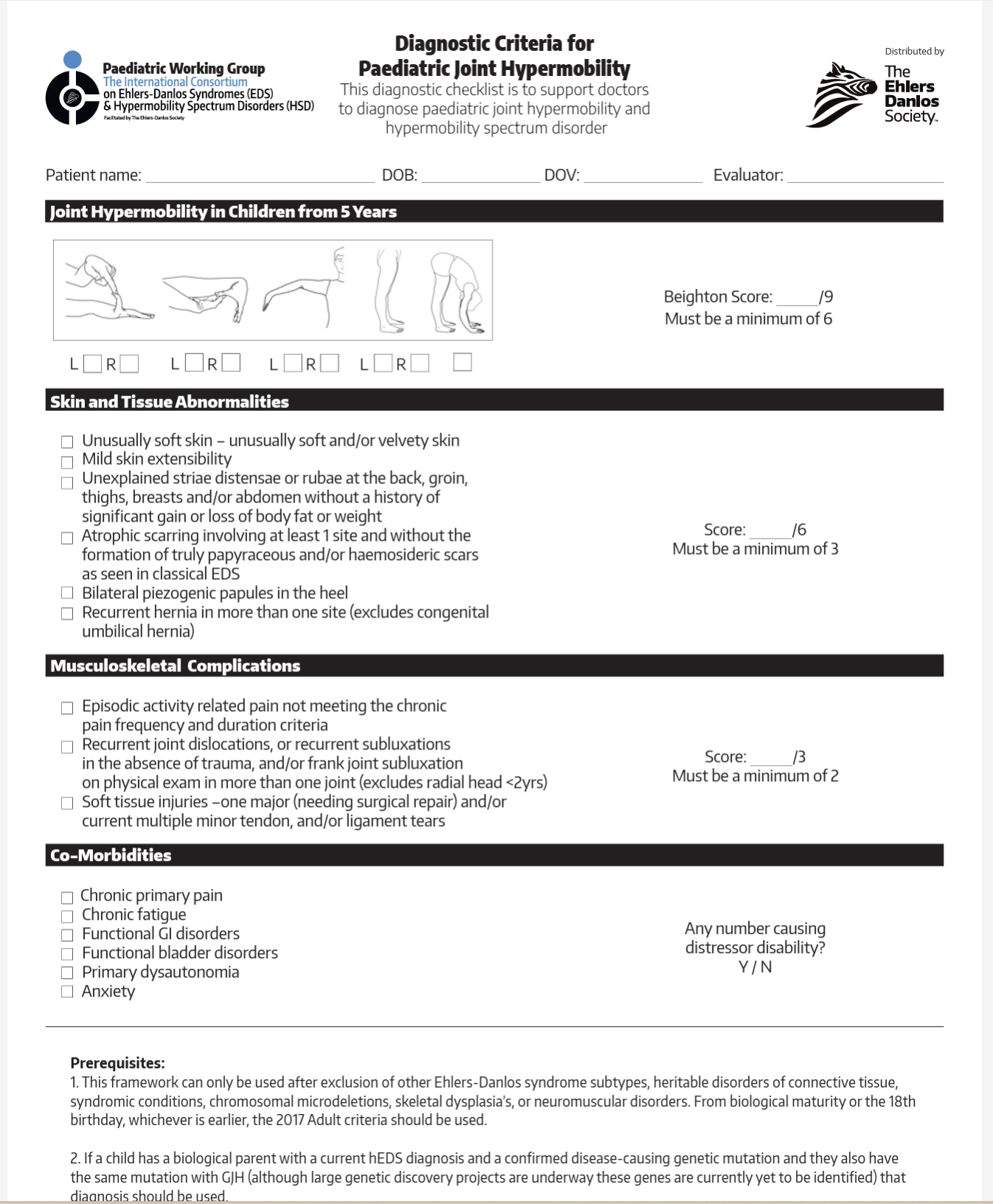
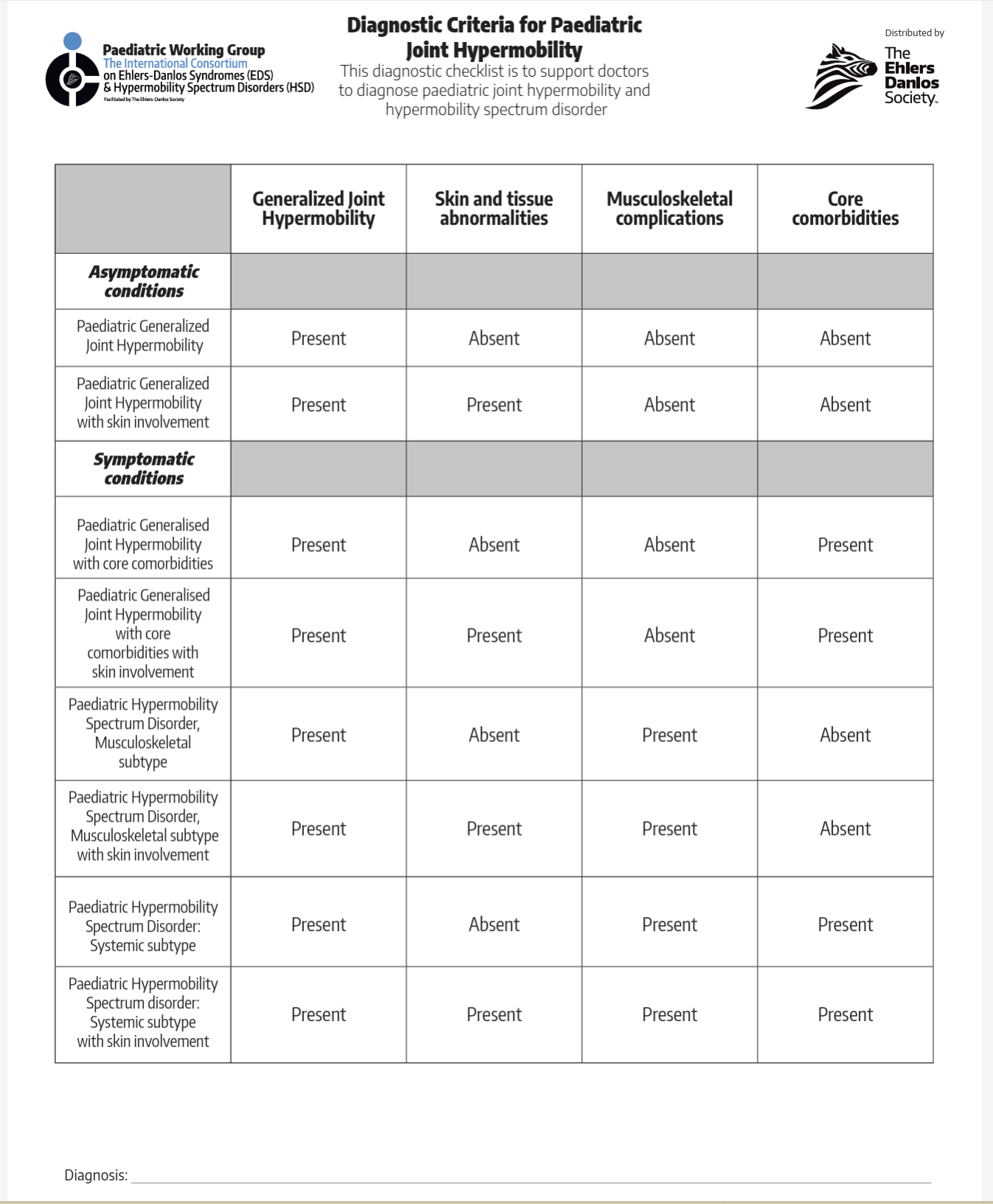
Pages one and two of the hEDS Pediatric Diagnostic Criteria. From Toft, Simmons, et.al, 2023.
Also available at the Ehlers-Danlos Society website.
GI/DIGESTIVE SYSTEM
High prevalence of gastrointestinal disorders in a large cohort of patients with joint hypermobility
Published in the Journal of Pediatric Gastroenterology and Nephrology in Jul 2024 | Link to full text
Research by Vibha Sood, Ajay Kaul, Khalil I. El-Chammas, Vincent A. Mukkada, Qin Sun, Lin Fei, and Neha R. Santucci
Summary: This scientific paper explores the high prevalence of gastrointestinal disorders in a group of children and young adults diagnosed with EDS (no subtype), hEDS or joint hypermobility syndrome (also known as HSD). Analyzing data from a large cohort found in patients records at Cincinnati Children’s Hospital Medical Center Gastroenterology from May 2011 through December 2017, the authors found that many patients with EDS, hEDS, HSD, or joint hypermobility experienced issues like constipation, difficulty swallowing (dysphagia), indigestion (dyspepsia), and even conditions like eosinophilic esophagitis and celiac disease, suggesting a strong connection between these seemingly unrelated conditions. The findings emphasize the importance of routine screening for GI issues in individuals with joint hypermobility to ensure timely diagnosis and treatment.
Hypermobility spectrum disorders and irritable bowel syndrome: A nationwide study
Published in the Journal of Gastroenterology and Hepatology in Dec 2023 | Link to full text
Research by Yair Zloof, Lidor Peretz, Maya Braun, Maya Simchoni, Avishai M. Tsur, Dorit Tzur, Estrela Derazne, Amir Ben-Tov, Orit Pinhas-Hamiel, Gil Amarilyo, Saleh Daher, Amir Shlaifer, and Yolanda Braun-Moscovici MD
Summary: This research paper investigates the relationship between HSD/hEDS and irritable bowel syndrome (IBS) in a large group of Israeli adolescents. Using a cross-sectional study of over 1.6 million individuals medically assessed before military service, the authors found a significant association between having HSD/hEDS and being diagnosed with IBS. Adolescents with hypermobility conditions had more than double the odds of also having an IBS diagnosis compared to those without. The authors suggest decreased motility in the gastrointestinal (GI) tract, altered collagen in the GI tract, hypersensitivity, and changes in the communication between the central nervous system and the enteric nervous system (the nervous system of the gut) could be the reason or reasons behind this connection. However, further research is needed to understand the underlying cause for this co-occurrence and to develop a specific treatment for individuals with HSD/hEDS and IBS.
Related: Check out a discussion of various GI issues that can affect EDS patients.
MISCELLANEOUS
Improving Social Media-Based Support Groups for the Rare Disease Community: Interview Study With Patients and Parents of Children with Rare and Undiagnosed Diseases
Published in JMIR Human Factors on Dec 30, 2024 | Link to full text
Research by Tom A. Doyle, Samantha L. Vershaw, Erin Conboy, and Colin M. E. Halverson
Summary: This paper explores how patients and parents of children with rare diseases utilize online support groups. Through interviews, the researchers found that these online groups are highly valued for providing access to specific information about conditions and symptoms, offering practical advice and resources, and fostering social connection with others facing similar challenges who may not be in the immediate geographical area. The study concludes with recommendations for improving the design and moderation of these online communities, such as making use of pinned posts, post tags, and allowing patients and caregivers—rather than medical professionals—to run the groups. This will help minimize redundant groups and enhance their overall usefulness and emotional support.
Physical activity and physical fitness in children with heritable connective tissue disorders
Published in Frontiers in Pediatrics on March 16, 2023 | Link to full text
Research by Lisanne de Koning, Jessica Warnink-Kavelaars, Marion van Rossum, Selina Limmen, Ruth Van der Looven, Laura Muiño-Mosquera, and Annelies van der Hulst
Summary: This research study, the first of its kind, investigates physical activity (PA) and physical fitness (PF) levels in 56 children diagnosed with heritable connective tissue disorders (HCTDs), such as Marfan, Loeys-Dietz, and Ehlers-Danlos syndromes. The study utilizes various objective measures like accelerometers and standardized tests to assess daily activity, cardiovascular endurance, and muscle strength in a pediatric population. The findings indicate that children with HCTDs generally exhibit reduced PA and PF compared to healthy peers, including more time sedentary and reduced cardiovascular and muscle strength. There’s a moderate positive correlation between their PA and PF levels. Additionally, pain and fatigue were a moderate cause of lower PA and PF levels, as would be expected. Rather than push children with HCTDs to be more active at all costs, parents and children should work with appropriately trained physical therapists, movement instructors, and doctors to create a plan tailor-made for the individual.
Related: Some accommodation ideas for K-12 students with EDS and related disabilities
The prevalence of multisystem diagnoses among young patients with hypermobile Ehlers–Danlos syndrome and hypermobility spectrum disorder: A retrospective analysis using a large healthcare claims database
Published in Medicine on Oct 11, 2024 | Link to full text
Research by Monika Kozyra MD, Regina Kostyun MSEd, ATC, PhD, and Sara Strecker, PhD
Summary: This observational study analyzed a large healthcare claims database to investigate the range of medical conditions experienced by young people between the ages of 10 and 24 who have been diagnosed with hEDS or hypermobility spectrum disorder (HDS). The research found that patients with hEDS and HSD, compared to a general population control group, experience a significantly higher prevalence of multisystem diagnoses, with digestive and cardiovascular issues being particularly common, but also including anxiety, depression, respiratory disorders, neurodevelopmental disorders, eating disorders, addiction, and obsessive-compulsive disorder (OCD). These findings highlight a substantial multisystem disease burden in this younger demographic, suggesting that these conditions extend far beyond musculoskeletal problems and warrant a broader clinical perspective.
Bonus article: CPP provides a more in-depth look at this study.
The Relationship Between Fatigue, Pain Interference, Pain-Related Distress, and Avoidance in Pediatric Hypermobile Ehlers–Danlos Syndrome
Published in Children on Jan 29, 2025 | Link to full text
Research by Olivia E. Sokol, Emma E. Biggs, Ardin S. Berger, Laura E. Simons, and Rashmi P. Bhandari
Summary: This article investigates the significant impact of fatigue on young people (age 8-17 in this study) experiencing chronic pain, particularly those diagnosed with hEDS. The study found that youth with hEDS experienced both greater severity and higher prevalence of clinically elevated fatigue compared to peers with other sources of chronic pain. The research highlights that this fatigue is significantly related to key factors, such as how much pain interferes with daily life, pain-related emotional distress, and the avoidance of activities, regardless of whether the youth had hEDS or other chronic pain. This suggests that addressing fatigue is crucial for improving treatment and overall well-being in children and adolescents living with chronic pain and hypermobility.
Related: Learn how to create your personal fatigue scale and say “goodbye!” to overdoing it.
NEUROLOGY/HEADACHE
Correlation between benign joint hypermobility syndrome and headache in children and adolescents
Published in BMC Musculoskeletal Disorders on May 2, 2024 | Link to full text
Research by Mohsen Jari and Sogol Alesaeidi
Summary: This research investigates the connection between benign joint hypermobility syndrome (BJHS) (often used interchangeably with HSD and sometimes hEDS in countries outside of the United States) and the occurrence of headaches in young people. The study found a significant correlation between BJHS and headaches, particularly migraines, showing that children with hypermobility were 3.7 times more likely to experience headaches than those without. Importantly, the study highlights that the probability of headache was higher in older children (12-16 years) with BJHS compared to younger ones—five times that of healthy controls for older children and 3.37 times for the younger group.
Hypermobility spectrum disorders and active migraine in Israeli adolescents: A nationwide study
Published in Headache: The Journal of Head and Face Pain in Jul 2023 | Link to full text
Research by Yair Zloof MD, Maya Simchoni BSc, Estrela Derazne MSc, Avishai M. Tsur MS, MHA, Dorit Tzur MSc, Maya Braun MD, PhD, Gil Amarilyo MD, Amir Shlaifer MHA, Asaf Honig MD, and Yolanda Braun-Moscovici MD
Summary: This extensive study investigated the relationship between HSD/hEDS and active migraine in a large group of Israeli adolescents. As in the hyperhidrosis and GI studies, researchers examined medical assessments of over 1.6 million young people before mandatory military service. They found a significant association: adolescents with HSD/hEDS were more than twice as likely to experience active migraine compared to those without these connective tissue disorders. This important finding, consistent across genders and in various analyses, highlights the need for increased clinical awareness to promote early diagnosis and treatment of migraine in individuals with HSD/hEDS rather than waiting on the migraine to strike unsuspecting patients.
ORTHOPEDICS/BONE HEALTH
Fracture prevalence in children diagnosed with Ehlers-Danlos Syndrome and Generalized Joint Hypermobility
Published in Child Abuse and Neglect: The International Journal in Jul 2024 | Link to full text
Research by Trances Yeung, Jennifer Smith, Roberto Mendoza-Londono, Constance O’Connor, Andrew Howard, Julia Sorbara, and Sarah Schwartz
Summary: This retrospective study investigates the link between EDS and Generalized Joint Hypermobility (GJH) (sometimes also called HSD) and bone fractures in children, particularly addressing whether these conditions could explain fractures in infants where child abuse is suspected. The researchers found children diagnosed with EDS or GJH at the Hospital for Sick Children in Toronto, Canada, between April 2017 and December 2021. The study found that while fractures are common in ambulatory children with EDS and GJH, mostly occurring in the limbs due to identifiable events, there were no fractures observed in infants under one year old within their study group. This suggests that EDS and GJH, as defined in this study, are not likely causes of fractures in infancy, which has significant implications in legal cases involving unexplained infant fractures. However, the study data is limited by self-reported answers from patients and family, inconsistent questions on intake forms, and the inability to confirm a fracture with complementing X-rays.
Related: What happens when EDS is mistaken for child abuse?
Outcomes of open reduction for hip dislocations in children with connective tissue disorders
Published in the Journal of Children’s Orthopaedics on Oct 11, 2024 | Link to full text
Research by Vineet M. Desai, Christopher J. DeFrancesco, Stefano Cardin, Carter E. Hall, and Wudbhav N. Sankar
Summary: This research addresses the positive and negative outcomes of open reduction surgery (creating an incision to fix broken bones or dislocated joints) for hip dislocations in children diagnosed with connective tissue disorders, including EDS. In fact, EDS was the most represented connective tissue disorder at 13% of patients in the study. The study looked at data from a single hospital and found that while most hips eventually achieved a stable position, a notable percentage experienced re-dislocation, residual acetabular dysplasia (a condition where the hip socket doesn’t fully develop after treatment), growth disturbance to the side of the femur that is closest to the hip , and surprisingly, stiffness after surgery, comparable to children without these disorders. Despite a higher re-dislocation rate than typically seen, which may be due to the small sample size, the findings offer valuable insights and highlight the challenges in managing hip dislocations in this patient population. A larger study would potentially find more actionable results.
PAIN
Exploring signs of central sensitization in adolescents with hypermobility spectrum disorder or hypermobile Ehlers- Danlos syndrome
Published in the European Journal of Pain in Jan 2025 | Link to full text
Research by Elke Schubert-Hjalmarsson, Anders Fasth, Kelly Ickmans, Ann-Charlott Söderpalm, and Mari Lundberg
Summary: This research article investigates potential indicators of central sensitization (a neurological process that intensifies pain signals) in adolescents diagnosed with HSD or hEDS, conditions often linked to chronic pain. The study compared adolescents with HSD/hEDS to a healthy control group, assessing pressure pain thresholds, exercise-induced hypoalgesia or pain inhibition after exercise (pain reduction after exercise), and levels of fatigue and cognitive/emotional factors. Findings suggested that adolescents with HSD/hEDS exhibited heightened pain sensitivity, less pain inhibition after exercise, and higher instances of fatigue and emotional difficulties. These results point towards central sensitization as a possible contributor to their symptoms as well as a possible complication to pain treatments.
Learn more: What are the different types of pain often found in EDS & HSD patients? Find out here!
Somatic symptoms, pain, catastrophizing and the association with disability among children with heritable connective tissue disorders
Published in the American Journal of Genetics in Jul 2023 | Link to full text
Research by Lisanne E. de Koning, Jessica Warnink-Kabelaara, Marion A. van Rossum, Dierderik Bosman, Leonie A. Menke, Fransiska Malfait, Rosa de Boer, Jaap Oosterlaan, Raoul H. H. Engelbert, and Lies Rombault on behalf of the Pediatric Heritable Connective Tissue Disorders Study Group
Summary: This article explores the connection between somatic symptoms (physical symptoms that are distressing and potentially interfere with life but have no physical explanation), pain, and the level of disability experienced by children with heritable connective tissue disorders (HCTDs), such as Marfan, Loeys-Dietz, and Ehlers-Danlos syndromes. The authors conducted a study to understand how common these issues are and how they relate to functional disability in children with HCTDs. Children ages 4 through 18 were included, and for children under seven, parents completed the surveys and questionnaires about somatic symptoms, pain presence, nature and intensity, catastrophizing, and functional disability. Crucially, they found that increased intensity of nonspecific somatic symptoms and pain were significant factors contributing to the challenges these children face in daily life, including functional disabilities. The findings highlight the need for comprehensive assessment and tailored treatment to address these factors in children with HCTD.
Related: Teens get real about how to survive high school with EDS.
The association of pain with gait spatiotemporal parameters in children with hypermobile Ehlers-Danlos syndrome and hypermobility spectrum disorder
Published in Gait and Posture in Mar 2024 | No free full text available; link to partial text
Research by Hyo-Jung Jeong, Joyce M. Engel, Michael Muriello, Donald Basel, and Brooke A. Slavens
Summary: This paper explores the connection between pain and walking patterns in children diagnosed with hEDS and HSD. The study found that while the average walking characteristics weren’t significantly different between children with hEDS/HSD and typically developing children, those with hEDS/HSD spent a longer percentage of time in the “stance phase” of walking—the part where the foot is on the ground. Prolonged stance phases were significantly associated with various aspects of pain (such as interference with daily activities and a tendency towards pain catastrophizing) and altered gait variability in children with these conditions. These findings suggest that assessing pain and its impact on gait could be helpful in understanding the challenges faced by children with hEDS/HSD, and, indirectly, help reduce fall risk.
Bonus article: Advice from moms about how they survive and thrive with children with EDS
PSYCHIATRY
Prevalence of psychiatric and sleep disorders and their impact on quality of life in children with hypermobile Ehlers-Danlos syndrome: an observational study
Published in Rheumatology on Mar 25, 2025 | Link to full text
Research by Amanda K. Hertel, Jordan T. Jones, Ashley Lytch, Emily Cramer, Ariana Schroeder, and William R Black
Summary: This research investigates the significant presence of psychiatric and sleep disorders in children and young adults with hEDS. The study found that a large majority of pediatric hEDS patients experience conditions like anxiety and depression, often alongside sleep problems, such as insomnia, obstructive sleep apnea, period limb movement disorder, and hypersomnia. These issues negatively affect the patient’s health-related quality of life (HRQoL). Importantly, the study highlights that anxiety and pain are the most significant factors predicting lower HRQoL in this population. The findings underscore the need for routine screening and integrated mental health and sleep care within the management of pediatric hEDS.
New research: Learn how EDS and various neurodivergent conditions may be related.
VASCULAR EHLERS-DANLOS SYNDROME
Vascular Ehlers-Danlos syndrome in children: evaluating the importance of diagnosis and follow-up during childhood
Published in the European Journal of Human Genetics on Dec 27, 2024 | Link to full text
Research by Niamh R. Wilkinson, Elena Cervi, Bart Wagner, Deborah Morris-Rosendahl, Duncan Baker, Harpaul Flora, Kate von Klemperer, Roby Andres, Neeti Ghali, and Fleur S. van Dijk
Summary: This research highlights the significance of early diagnosis and ongoing care for children with Vascular Ehlers-Danlos syndrome (vEDS). The study analyzed data from 63 children in the UK, under the age of 18 and genetically diagnosed with a molecularly confirmed pathogenic variant of the COL31A gene. The authors lament the lack of guidelines and information available for parents of pediatric vEDS patients and for the patients themselves. They found that while events like ruptures or perforations are less common in children than in adults, they can still occur—even in the neonatal period—and require timely surgical intervention. Diagnosis of vEDS is often prompted by a positive family history or certain clinical features, most commonly easy or excessive bruising. They argue that vEDS should be considered in all children with unexplained severe bruising, even in the absence of other symptoms of vEDS. Early genetic testing and diagnosis in these situations can allow for proactive management, timely follow-up, and improved outcomes, potentially reducing serious health complications later in life.
Related: Donna Sullivan writes about the frustrations involved in getting genetic testing for children.
Association Between Cardiac Size, Systolic Function, and Complications in Vascular Ehlers-Danlos Syndrome
Published in the Canadian Association of Radiologist Journal on September 6, 2024 | Link to full text
Research by Aly Fawzy, William Warnica, Kate Hanneman, Rachel M. Wald, Erwin Oechslin, Paaladinesh Thavendiranathan, and Gauri R. Karur
Summary: This study investigates cardiac health and its association with complications in individuals diagnosed with vEDS. Using cardiac MRI, the researchers assessed heart size and pumping ability (systolic function) in vEDS patients compared to healthy controls. Key findings indicate that vEDS patients exhibit lower left and right ventricular ejection fractions (LVEF and RVEF) and that larger left ventricular size and reduced LVEF are significantly linked to a higher incidence of vEDS-related complications such as arterial dissections, aneurysms, and spontaneous pneumothoraxes. These results suggest a potential primary cardiac involvement in vEDS, beyond just vascular issues and the importance of cardiac imaging in monitoring and predicting disease progression.
AI was used to assist in the summarization of the articles presented above.
Kate Schultz
July 2025