Managing Symptoms

Up Close and Personal: Our Team’s Favorite Go-To Support Aids for EDS/HSD
This month, we wanted to give you a peek into the daily lives of our team members by asking them to share a few of their favorite go-to supportive items for Ehlers-Danlos syndromes (EDS) or hypermobility spectrum disorders (HSD). While these aids might be what work for us personally, we hope they offer inspiration and ideas to help you live your life to the fullest with EDS/HSD.

Measuring the Unmeasured
What Two New Studies Say About the Head, Neck, and hEDS People with Ehlers-Danlos syndrome have heard for years that their symptoms are “in their head.” In one sense, that may be true—but not in the way we all hate to hear. When it comes to symptoms like headaches, nausea, dizziness, brain fog, visual disturbances, […]

Research Round-up, Edition Six
Previous editions of Research Round-up can be found at the following links: Edition 5 (Pediatrics) Edition 4 (Neurodivergence) Edition 3 Edition 2 Edition 1 Howdy, partners! This Research Round-up has roped in a whole herd of topics for you. We hope you enjoy the read, learn a thing or two, and feel […]
Cerebral Venous Outflow Disorders: What it is and Why EDS Patients Should Know About it
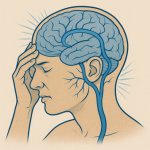
Cerebral venous outflow disorders describes a spectrum of conditions related to issues with how fluid drains from the brain.Experts are observing a connection between connective tissue disorders (like hypermobile EDS) and cerebral venous outflow disorders. Cerebral venous outflow disorders can cause pressure headaches (that often worsen when lying flat), dizziness, pulsatile tinnitus (a rare vascular form of tinnitus), neck pain, tenderness at the base of skull, vision disturbances, ‘brain fog’, and cognitive dysfunction. Cerebral venous outflow disorder may look different when it presents in individuals with connective tissue disorders than in individuals without, creating diagnostic challenges.

The Quiet Weight of Chronic Illness Grief
Living with a rare, chronic illness is profoundly isolating—not only physically, but emotionally. Even when surrounded by others, I often feel like a ghost, disconnected from the world around me. I remember sitting at a party, listening to conversations that once felt familiar, and being hit with the stark contrast between their lives and mine. […]

Out of Spoons: A Spoonie-Centered Coloring Book from Author and Artist Jules Machias
Life with chronic illness rarely comes with downtime—or at least, not the kind we choose. For those living with Ehlers-Danlos syndrome (EDS), ME/CFS, lupus, fibromyalgia, autoimmune diseases, or any other related condition that affects your spoons, rest is often a necessity. Author and artist Jules Machias, who lives with EDS, knows this firsthand. Their new […]

Understanding Your Flare Fettered Friend
Has a friend recently told you: I feel a pain flare coming on, I’m in a flare, or I’m coming out of a flare? If so, what does this mean for them and what does it mean for you? Maybe you want to help but are unsure how? In this article, guest author Avi, who […]
New Pain Killer on the Market: Suzetrigine
Summary The medicine is sold as Journavx, with the chemical name Suzetrigine. It works by blocking NaV1.8 channels, which are responsible for pain transmission along nerves. It only affects peripheral nerves (outside the brain and spinal cord), such as those in the arms and legs. It does not cause addiction. However, Journavx is weaker than […]