
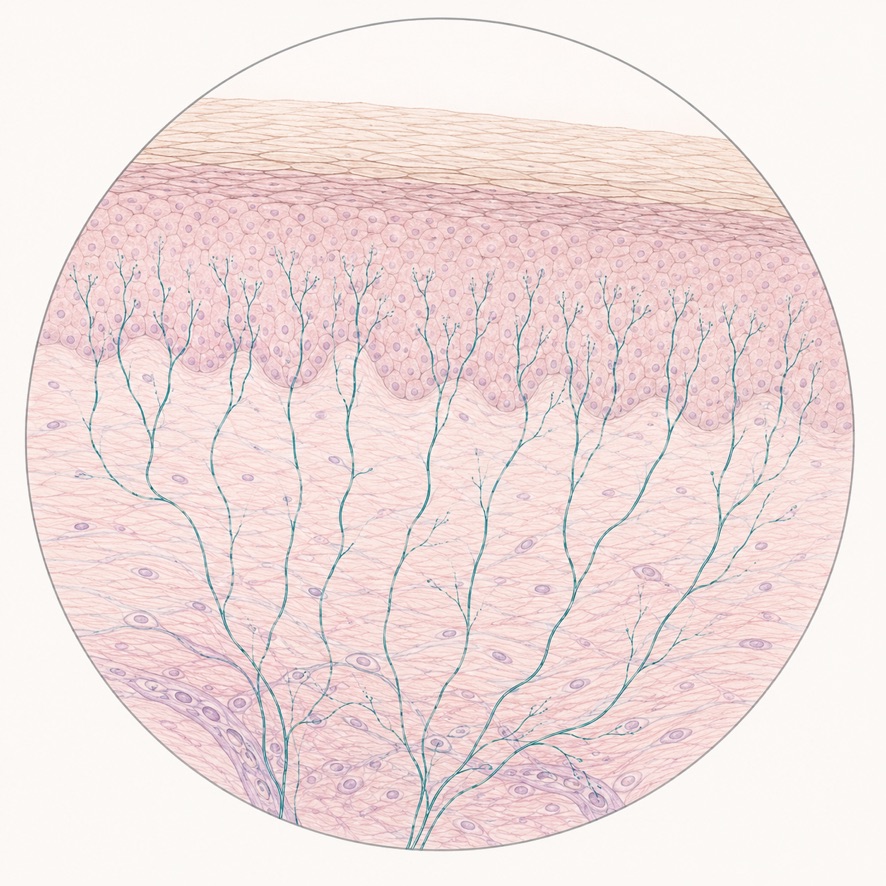
For many people living with hypermobile Ehlers-Danlos syndrome (hEDS), one of the most frustrating aspects of the condition is pain that feels impossible to explain — burning sensations, widespread sensitivity, symptoms that seem to involve the whole body rather than just the joints. Standard neurological tests often come back normal, leaving patients without answers and sometimes without validation. A new study published in Scientific Reports suggests that what is happening beneath the skin in hEDS is more complex, and more measurable, than previously understood.
What Is Small Fiber Neuropathy?
To understand the study’s findings, it helps to first understand what small fiber neuropathy, or SFN, is. The nervous system contains many types of nerve fibers. Large fibers handle functions like movement and coordination. Small fibers, by contrast, are responsible for sensing pain and temperature, and for regulating the autonomic nervous system, the part of the nervous system that controls automatic body functions like heart rate, digestion, sweating, and blood pressure. When these small fibers are damaged or lost, the result is small fiber neuropathy, a condition characterized by burning pain, abnormal sensations, and a wide range of autonomic symptoms such as dizziness on standing, gastrointestinal problems, and heat intolerance.
SFN has been identified in a significant proportion of people with hEDS, but until now, no study had systematically compared how SFN presents in hEDS compared to how it presents in people who have SFN without any underlying connective tissue disorder.
How the Study Was Done
Researchers in Italy enrolled 35 patients who met the 2017 diagnostic criteria for hEDS and also had confirmed SFN, referred to throughout the study as the hEDS/SFN group. They compared this group to 38 patients of similar age who had SFN without any known underlying cause, referred to as idiopathic SFN, or iSFN. All participants underwent a comprehensive battery of assessments including standardized symptom questionnaires, sensory testing to evaluate how well patients could detect temperature and touch, autonomic testing to evaluate how the involuntary nervous system was functioning, and skin biopsy to directly examine nerve fiber density under a microscope.
Skin biopsy is a minimally invasive procedure in which a small sample of skin, typically from the leg, thigh, and fingertip, is examined under a microscope to count and assess the nerve fibers present. It is currently one of the most reliable tools for confirming small fiber neuropathy.
What They Found: The Pain Picture
One of the most striking findings was how much earlier symptoms began in the hEDS/SFN group. On average, patients with hEDS/SFN reported symptom onset at around age 19, compared to age 35 in the iSFN group, a difference of roughly 16 years. This earlier onset was accompanied by a longer disease duration by the time of diagnosis, suggesting that many people with hEDS may be living with unrecognized nerve involvement for years or even decades before it is identified.
Pain in the hEDS/SFN group was also more widespread. While burning sensations, pinprick pain, and abnormal sensitivity were present in both groups, they were significantly more common and more generalized in hEDS/SFN patients. Notably, pain in the perineal region, an area not typically associated with SFN, was reported in 34% of hEDS/SFN patients and in none of the iSFN patients. The authors suggest this may be related to nerve displacement caused by tissue laxity, a feature unique to connective tissue disorders.
What They Found: The Autonomic Picture
Autonomic symptoms, those involving the involuntary functions of the body, were significantly more severe in the hEDS/SFN group across nearly every domain measured. These included orthostatic intolerance, or difficulty maintaining normal blood pressure and heart rate when standing, gastrointestinal symptoms such as reflux, slow digestion, and alternating constipation and diarrhea, urinary urgency, dry skin, and heat intolerance.
Perhaps the most striking autonomic finding was the rate of Postural Orthostatic Tachycardia Syndrome, or POTS, a condition in which heart rate increases abnormally upon standing, causing dizziness, palpitations, and fatigue. POTS was diagnosed in 51.5% of hEDS/SFN patients, and in none of the iSFN patients. While the connection between hEDS and POTS is well established in the literature, this study adds an important new dimension: the data suggests that dysfunction of the peripheral autonomic nervous system, meaning the nerve fibers themselves rather than just blood vessel laxity, may be a contributing mechanism. This is a meaningful distinction for patients, because it points toward neurological evaluation and management as part of comprehensive hEDS care.
Sweating function was also impaired to a greater degree in hEDS/SFN patients, with significantly reduced sweat output compared to the iSFN group. The authors note that reduced sweating can amplify POTS-related symptoms like fatigue and exercise intolerance, and may help explain the heat intolerance and dry skin commonly reported by people with hEDS.
Under the Skin: What the Biopsy Revealed
Skin biopsy findings confirmed nerve fiber loss in both patient groups, with one important distinction. While the overall loss of sensory nerve fibers in the outermost layer of the skin was similar between groups, the hEDS/SFN group showed significantly greater loss of autonomic nerve fibers, particularly those involved in sweating, at the thigh. This pattern of autonomic fiber loss was nearly two and a half times more common in hEDS/SFN patients than in those with iSFN.
The biopsy also revealed an unusual pattern in hEDS/SFN patients: areas of nerve fiber loss alternating with clusters of fiber regrowth. The authors interpret this as evidence of a chronic, slow-progressing process in which the nervous system attempts to repair itself over time. This ongoing cycle of degeneration and attempted regeneration may itself contribute to the severity and variability of pain experienced by people with hEDS.
Taken together, these findings support the idea that small fiber involvement is not a coincidental feature of hEDS but rather a core component of the condition, one that affects both the sensory and autonomic nervous systems in ways that are distinct from SFN arising from other causes.
Key Takeaways
- People with hEDS who have SFN experience symptom onset significantly earlier, by approximately 16 years, than people with SFN from other causes.
- Pain in hEDS/SFN is more widespread and more severe, affecting areas of the body not typically involved in other forms of SFN.
- Autonomic symptoms, including POTS, gastrointestinal dysfunction, sweating abnormalities, and heat intolerance, are substantially more severe in hEDS/SFN than in iSFN.
- POTS was present in over half of hEDS/SFN patients and in none of the iSFN patients, with evidence pointing to peripheral nerve dysfunction as a contributing mechanism.
- Skin biopsy revealed greater autonomic nerve fiber loss in hEDS/SFN, particularly at the thigh, a finding not captured by standard neurological testing.
- Nerve punch biopsies revealed alternating areas of nerve fiber loss and regrowth in the hEDS/SFN group, suggesting an ongoing cycle of damage and attempted repair that may contribute to the severity and variability of pain
- Small fiber involvement appears to be a core feature of hEDS rather than a secondary complication.
Final Thoughts
For the hEDS community, the implications of this research are both validating and actionable. The pain and autonomic symptoms that so many people with hEDS experience are not only real, they are measurable, and they follow a distinct pattern that sets hEDS apart from other forms of neuropathy.
The authors specifically recommend that systematic autonomic assessment be incorporated into the clinical evaluation of hEDS. For patients, this means that requesting autonomic testing and, where appropriate, skin biopsy, is a well-supported ask, and one that could lead to more accurate diagnosis and more targeted treatment. Understanding the neurological dimension of hEDS is not just a matter of scientific interest. It is a step toward better care.
Study Referenced
https://www.nature.com/articles/s41598-026-60461-6
Jacqueline Moltzau Anderson, PhD, Author
Researcher at University of California
August, 2026




I have hEDS that was diagnosed almost 8 years ago and small fiber neuropathy dx by skin biopsy in my ankle at least 30 years ago.
I am almost 68 years old now. I have had pots, urinary urgency and incontinece, constipation alternating with diarrhea, severe nerve pain, burning feet, and wrists, exercise intolerance-