July is a busy month in the Ehlers-Danlos world. The EDS Society’s Annual Global Learning Conference takes place in Allen, Texas, on July 24-26. It will feature a great lineup of esteemed physician speakers, patient organizations, advocates, and presentations covering this year’s theme: “Exploring Comorbidities in EDS & HSD.” It is also the Ten-Year Celebration of the founding of the Ehlers-Danlos Society, an event that I remember and a milestone that caused me to pause and reflect on how far we have come, where we remain stuck, and how much further we still need to go.
As a patient, caregiver, and longtime advocate, I am excited to attend this year’s conference. Not only because our film, Complicated, will be showing, but because it is exciting to see the focus on the overlapping and co-occurring conditions that create complexity. These immune, neurological, gastrointestinal, and vascular conditions are often where disability unfortunately begins. Yet they are frequently questioned or dismissed by physicians, highlighting the urgent need for better research, diagnostic recommendations, coordinated care, and clinical guidance.
It is encouraging to see the emerging research, new healthcare voices, industry, and sponsors coming together to try to solve the many issues with connective tissue. And while it is great that the medical world is catching up on these co-morbid conditions, we patients have known about and been living with them for a very long time, and funny enough, I have proof.
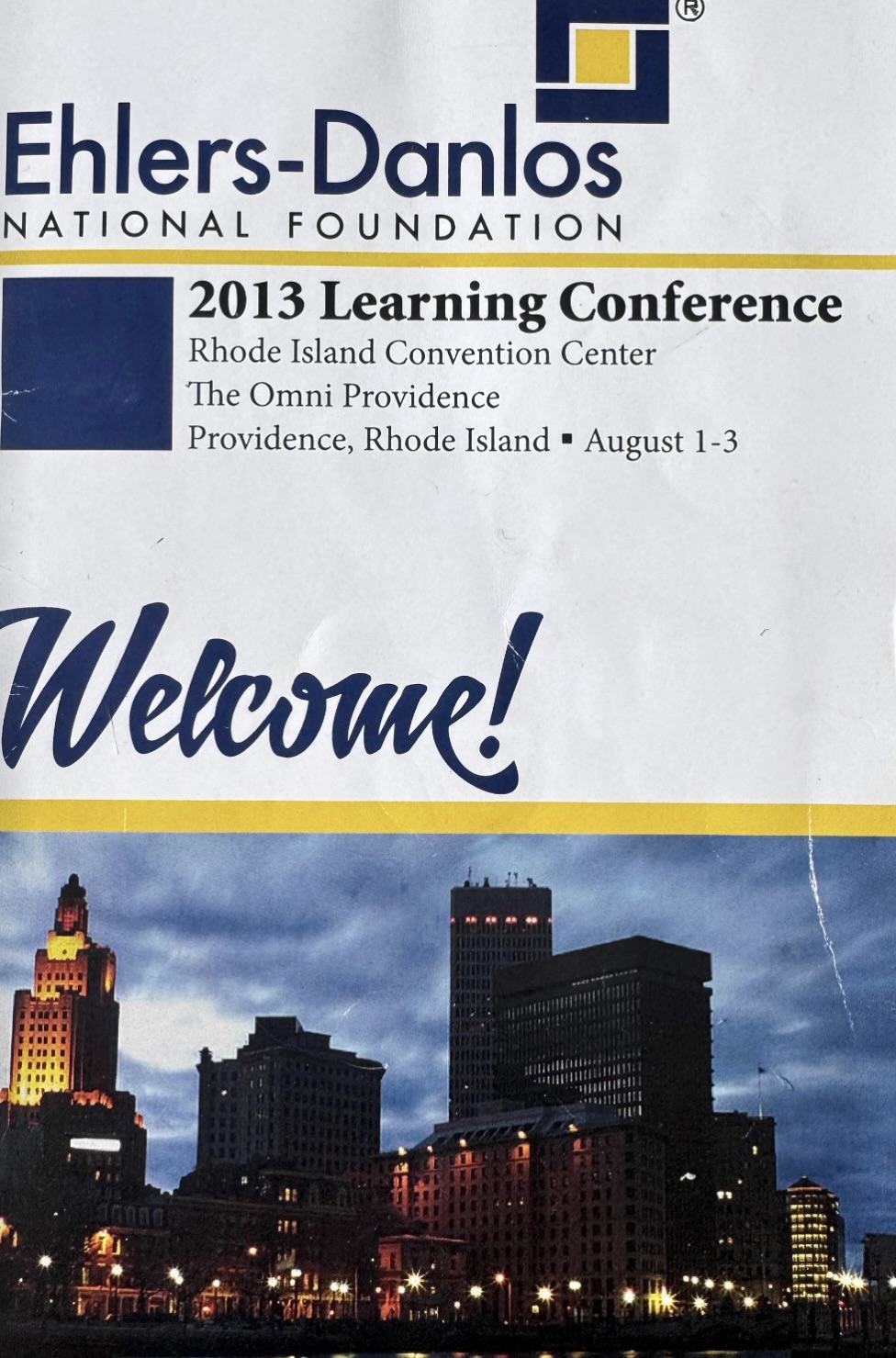
I was recently working on a project at home (cleaning out a closet that was apparently long overdue), and I came across a brochure from the first Ehlers-Danlos Conference I had attended in 2013. You can check it out here if you are curious.
I was a young mother at the time, with three kids struggling with a long list of symptoms and this new diagnosis of EDS, a condition that my pediatrician openly admitted he had never heard of and knew nothing about. I was thrilled to have found this event that was hosted by The Ehlers-Danlos National Foundation, the organization that started it all. Sponsors supporting that gathering included our own, Chronic Pain Partners, The Silver Ring Splint Company, YouScript/Genelex (Invitae today), The Coalition Against Pediatric Pain, Purdue Pharma, and Bauerfeind.
The pamphlet itself is a real time capsule of information, featuring pioneering physicians, nonprofit organizations, and the people who started this effort that led to this ten-year celebration. People like Dr. Claire Francomano, Dr. Frasier Henderson, Dr. Pradeep Chopra, Maggie Buckley, Shani Weber, and others who remain hard at work today. For example, Dr. Rodney Grahame’s session from 2013, “What Should We Call Our Syndrome?” seems ironically timely again, as the EDS community waits to see if there will be any nomenclature updates in the upcoming new diagnostic criteria.
Dr. Alan Pocinki’s “Pseudopsychiatric Symptoms in EDS” and Dr. Richard Barnum’s “Psychiatric Questions in Pediatric Pain Disorders” clearly were early attempts to address the problems of psychological misdiagnosis. Their educational message is impressive when you consider that the term “gaslighting” was neither used nor acknowledged as a problem in medicine at the time. Unfortunately, their early work did not seem to gain traction, as psychological misdiagnosis remains one of the more prevalent challenges that people with EDS encounter, even today.
I remember feeling such relief attending those early seminars on comorbid conditions such as POTS, TMJ, pain management and GI issues, because they helped me to tie together all of the symptoms that my kids were experiencing. I was so grateful to have found people who understood and shared so many of the challenges that my young family and I were navigating and to discover resources for information and support. That is the true power of community that patient events like this create.
It was at this conference that I first met Karen Richards, the indomitable young woman featured in our film, Complicated. At the time, she was a vibrant 12 year old running around the conference trying to convince the other kids to come and hang out in her hotel room for snacks and “to party.” She also had managed to leave Professor Rodney Grahame speechless when she boldly told him, “I have a lot of doctors, they hear me but they don’t listen to me.”
I also remember meeting Dr. Frasier Henderson in the lobby and nervously showing him a photo of my daughter’s X-ray that had confounded her orthopedist. He immediately understood why her fusion had failed and gave me advice that helped me to navigate through some uncertain surgical times. I left that conference feeling hopeful and empowered, knowing that I now had greater knowledge of the conditions affecting my family, and that I could get them the care they needed.
I guess that is the memory here that hurts the most.
Over the next ten years, despite my knowledge of medical research on EDS and personal relationships with many physicians in the space, I still struggled greatly to find informed care and spent an inordinate amount of time, money, and travel trying to do so. In full transparency, I still am, as Covid and complex neurological symptoms created new medical challenges for my family.
Research and knowledge about a condition is important, but establishing clear diagnostic guidelines, education and support for physicians, and building accessible care pathways and models of care coordination for patients are CRITICAL.
I have had many people give feedback after watching our film, asking why we chose to showcase such serious issues and complexity. The answer is simple: those are the symptoms that, when overlapping, can make it extremely difficult to receive cohesive care.
Next week, when I land in Texas, I look forward to seeing these comorbid challenges take center stage. I will grab another brochure and tuck it away, hoping that in ten years (when I clean out that closet again), the challenges of accessing diagnosis and care will be just a memory.
DM Sullivan, Author
Producer, Complicated
Founder & Executive Director, Elevate Rare
July, 2026