Scoliosis and Ehlers-Danlos Syndrome (EDS) frequently go hand-in-hand. In this article, we cover the essentials of scoliosis and its prevalence in the EDS community. Next, we spotlight a highly regarded yet lesser-known approach for treating scoliosis called the Schroth Method. To help you decide if it is right for you, we caught up with Schroth-certified physical therapist Caroline Campesi, DPT, to share her expert insights on using this method for hypermobile bodies.
What Is Scoliosis?
Scoliosis is an atypical curvature of the spine that commonly develops during periods of rapid growth, such as adolescence. It is generally considered a progressive condition, meaning the degree of curvature (measured using the Cobb angle) can increase over one’s lifetime.
Why This Matters for EDS
EDS are connective tissue disorders characterized by joint hypermobility and tissue laxity. This can make it difficult for individuals with EDS to maintain proper spinal alignment and stability. According to research, scoliosis is common, affecting 29% of individuals with EDS, with most having mild scoliosis (87.5%, Cobb angle 10–24°), and a smaller proportion classified as moderate (12.5%, Cobb angle 25–40°). A rarer subtype, kyphoscoliotic EDS (kEDS), is associated with more severe scoliosis.
Common Signs of Scoliosis
Many individuals may not even be aware they have mild scoliosis until problems arise, such as back pain or spasms. Here are some signs to look out for:
- One hip or shoulder positioned higher than the other
- Asymmetry of the rib cage or back
- One shoulder blade appearing more prominent
- A visible rib or back hump when bending forward
- Changes in posture or spinal alignment
Treatment
While surgery is reserved for more severe forms of scoliosis, mild to moderate scoliosis is often best managed with conservative approaches such as bracing (often when children are still in the growing phase) and physical therapy. Scoliosis-targeted physical therapy, such as Schroth Method, can help stabilize the spine and arrest further progression.
What Is the Schroth Method?
The Schroth Method is a highly tailored evidence-based form of physical therapy calibrated to each individual’s unique curve pattern. Rather than a one-size-fits-all approach, it works to elongate and de-rotate the spine, correct muscle asymmetry, and foster greater postural awareness. This is particularly important for those with EDS or Hypermobile Spectrum Disorder (HSD) as this method builds the deep muscular strength required for spinal stability, providing the support that hypermobile bodies often lack. It is important to remember, however, that while the Schroth method can improve one’s curve and rotation, the extent of that correction is highly individual. In many cases, particularly in adults, the primary goal may be arresting progression and improving day-to-day functionality.
As hypermobile bodies are prone to joint and spinal instability, individuals with EDS should avoid ‘end of range’ stretching. This is important to note, as some Schroth exercises involve spinal elongation through stretching or hanging on Schroth stall bars. While these movements may look intimidating, Schroth emphasizes active muscle engagement during spinal elongation (such as scapular stabilizers, back, and abs), rather than passive hanging. Thus, these exercises can be appropriate for individuals with EDS when expertly guided and supervised. Still, if something doesn’t feel right, speak up! As with any physical therapy approach, the key is working with a physical therapist who understands hypermobility and can tailor exercises so that they feel appropriate for you.
Click here to learn more about the Schroth Method.
Schroth Method for Scoliosis in EDS: An Expert Q&A
While the Schroth Method is a highly regarded approach for scoliosis, hypermobile bodies often require modified care. To better understand how scoliosis manifests in individuals with Ehlers-Danlos syndromes (EDS) and how the Schroth Method can be appropriately applied in this population, we reached out to Caroline Campesi, DPT, a Schroth-certified physical therapist, to gain her expert perspective.
- Can you tell us a little bit about what drew you to the Schroth Method?
I started my physical therapy career in general orthopedics and was seeing a high volume of folks with neck and back pain. I kept looking at their torsos and thinking, “something is off here”, but possessed no skills for assessment of spinal asymmetry/scoliosis. In PT school, scoliosis was touched on during a lecture just one time; I’d be surprised if we spent even a full hour discussing it.
I say that scoliosis found me. It kept showing up in my clinic and my desire to get better at diagnosis and treatment of this condition pushed me to attend my first Schroth training in 2019. And I was hooked on day 1. It’s such a detailed assessment and treatment system, and patients respond incredibly well to Schroth. My husband, Eric Campesi, is also a Schroth-trained therapist and we marvel at the high percentage of patients who show significant clinical gains within the first few visits of Schroth. We’ve been therapists for 14 years and we’ve never seen anything like it.
- What percentage of your scoliosis clients have EDS, HSD or another connective tissue disorder?
A huge percentage. So many of our patients fall somewhere on the hypermobility spectrum (such as EDS or HSD) that I’m often surprised when I evaluate a new patient and they don’t have this.
I treated 22 patients last week, and 13 of them scored higher than 5/9 on the Beighton score. And last week’s numbers seem lower than my caseload as a whole (meaning I believe more like 75% of my caseload has some form of connective tissue disorder).
- The majority of individuals with EDS who have scoliosis have mild scoliosis (87%). In your experience, though, does the Cobb angle reliably correspond to symptom severity or functional impact in this population?
Absolutely not. People with EDS can be extremely symptomatic – in their spines but also often in other joints due to the systemic nature of EDS. Plus, they may have visceral symptoms (GI issues, cardiovascular issues including dysautonomia, etc.) because connective tissue not only resides around our joints but also in our arteries and intestines. Connective tissue is everywhere. So, the functional impact of EDS goes far beyond the presence of mild scoliosis. Patients often come to me for what they perceive is solely a scoliosis problem, and I help them understand which symptoms are a direct result of the scoliosis and which ones are likely the result of a different system because of their connective tissue disorder.
- Based on your clinical observations, do clients with EDS-related scoliosis tend to show different patterns of progression compared to those without EDS?
You’d think the answer to this question would be an easy, resounding yes, but scoliosis has mysterious elements to it. Most of our teens with Adolescent Idiopathic Scoliosis (AIS) are hypermobile, BUT a few are not, and in both cases, progression can be rapid during growth spurts. My husband Eric and I think progression is more complex than the laxity or stiffness of the connective tissues around the spine, and we actually now have data showing that active teens show less scoliosis progression than their sedentary counterparts. The pattern that emerges more often in the clinic mirrors this: those who move more frequently throughout the day (whether that is formal exercise or because they have a non-sitting job) show less progression and are less symptomatic throughout the lifespan.
- What distinguishes the Schroth Method from traditional physical therapy for EDS patients, and are there specific contraindications or patients for whom this approach might not be appropriate?
If you show up at traditional PT for your scoliosis, your therapist will likely give you the same exercises that they give to all of their patients who come to them for a neck or back problem: bird dogs, dead bugs, planks, clams, bridges. These are great exercises, and they will certainly strengthen your back, core, and glutes, but they are not scoliosis-specific. They will not re-organize your torso to put you into a more symmetrical, balanced posture, or address muscular asymmetries. This is where Schroth comes in. A Schroth-trained therapist will assess the 3-dimensions of spinal alignment and develop a program to help you correct all of them, as well as right to left torso, scapular, and hip muscle asymmetries. A scoliosis-specific program like Schroth can prevent further scoliosis progression and in some cases, straighten the spine.
- EDS, in particular Hypermobile EDS, can come with many comorbidities, such as Postural Orthostatic Tachycardia Syndrome. How do you adapt Schroth sessions to accommodate these challenges?
Unfortunately, many people with EDS and POTS are either undiagnosed or under diagnosed/undertreated, so I first flag these issues if present, and refer out for better diagnosis and therefore better medical management. I’ve seen patients with well-managed POTS who are functionally doing very well and in contrast patients with poorly managed POTS either due to lack of diagnosis or under treatment. If you’re having an excessive increase in your heart rate every time you sit up or stand up you’re not going to do well with any sitting or standing activity, so I use the motto “first things first”, prioritizing POTS stability. I am never afraid to refer out.
Of course, other limitations can pop up in this population (noisy joints, subluxing or dislocating joints), and I’m always ready to adapt an exercise position to accommodate. I believe in making the exercise fit the person, not the other way around. Getting creative and problem solving are part of my daily job tasks and I’m ok with that. I often say “I get all the complicated cases” and, again, I am 100% ok with that.
- What outcomes can EDS clients realistically expect from Schroth?
Improved spinal, scapular and hip joint stability via the small stabilizing muscles being activated and strengthened. Better posture. Strategies for improving spinal alignment based on what each patient’s responsibilities are throughout the day. A toolkit to self-address musculoskeletal pain, whether it be myofascial release with a foam roller or tennis ball to an affected area or use of a lumbar roll with prolonged sitting to support the back in its neutral lordosis. And a mindset that you can and should exercise if you have EDS, it just may look a little different than the stiffer-bodied person next to you at the gym.
- For individuals with EDS who are considering Schroth therapy, what should they look for when trying to find a therapist who is familiar with both the Schroth Method and connective tissue disorders?
Any Schroth therapist who solely works with scoliosis and kyphosis should be well-versed in connective tissue disorders. You can’t not be, because such a high percentage of your patients will have a connective tissue disorder. If a Schroth-trained therapist merely dabbles in scoliosis and spends the majority of their clinic time working on ankle sprains or post-joint replacement, don’t expect them to know a lot about connective tissue disorders, because that’s not what’s in front of them all day long. The simple question of “what percentage of your patients have scoliosis and EDS or HSD?” is a great place to start.
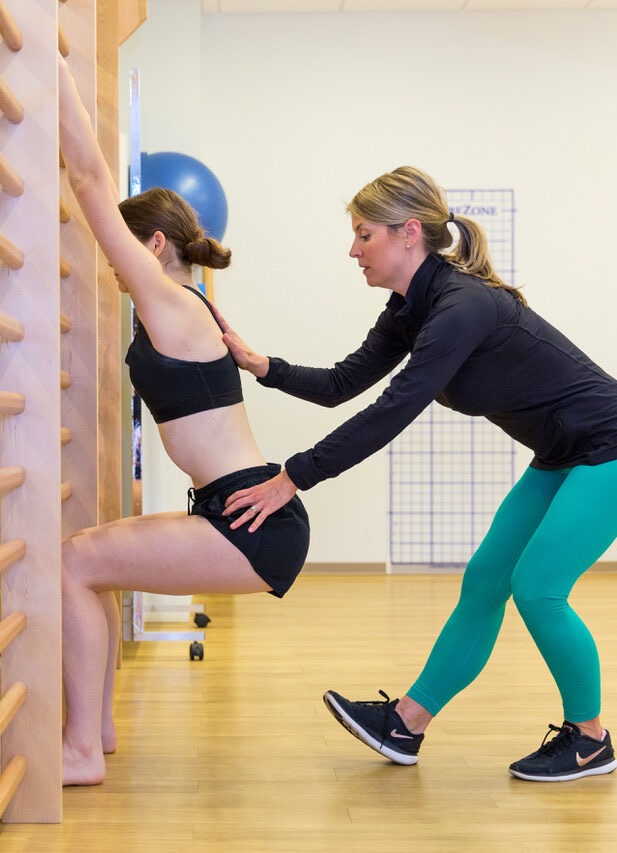
Caroline Campesi, DPT, with one of her clients at her clinic
Jacqueline Teti, author and patient
with Hypermobility Spectrum Disorder
February, 2026