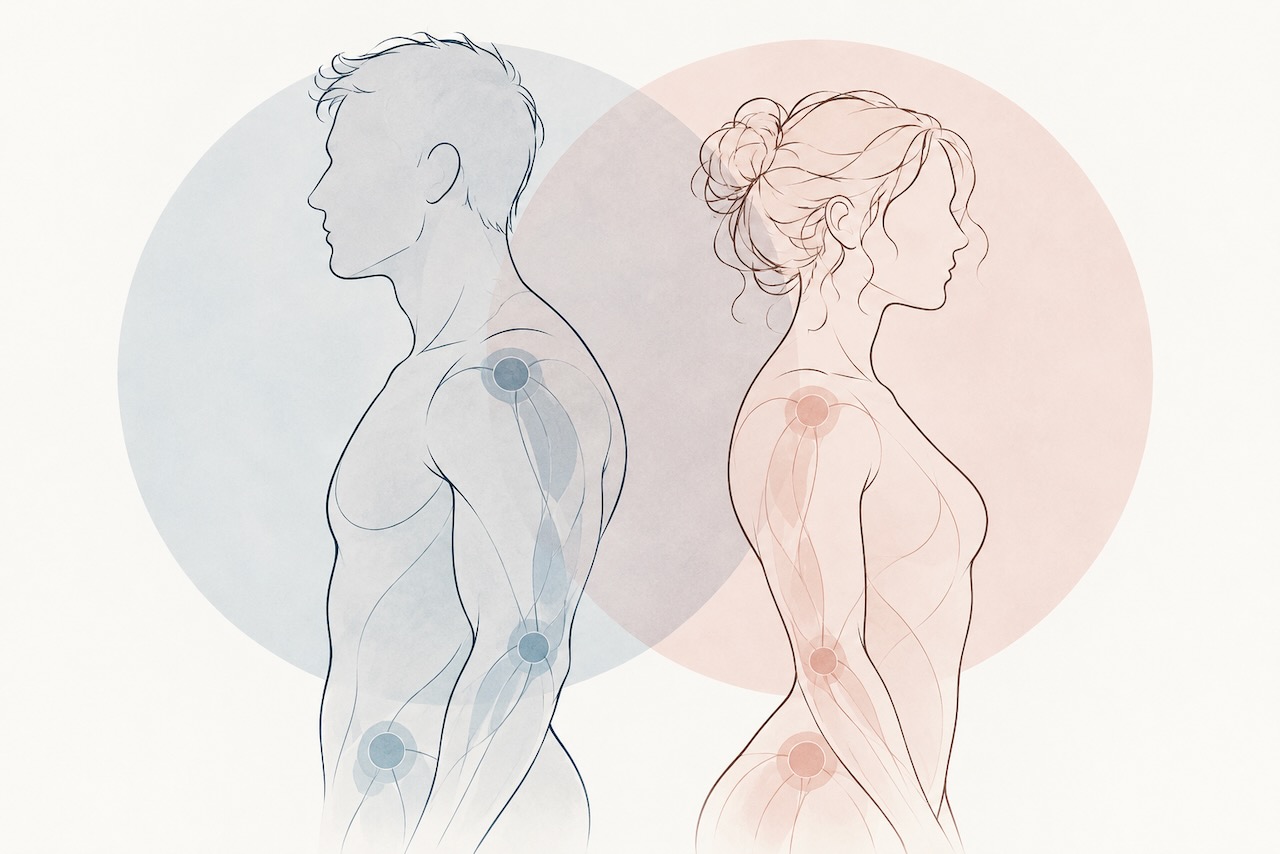
Hypermobile Ehlers-Danlos syndrome (hEDS), and the closely related hypermobility spectrum disorders (HSD), are commonly thought of as conditions that primarily affect women. Walk into any EDS support group, online community, or clinic waiting room, and the overwhelming majority of people there will be female. But does that mean men are truly less affected, or does it mean they are less likely to be recognized, diagnosed, and counted?
A 2026 new study from the Mayo Clinic’s EDS Clinic in Florida offers a comprehensive look at how symptoms and comorbidities in hEDS and HSD differ between men and women. The findings are nuanced, important, and carry real implications for how men with these conditions are identified and cared for.
About the Study
Researchers analyzed self-reported health data from 2,451 adults diagnosed with hEDS or HSD at the Mayo Clinic’s Florida EDS Clinic between 2019 and 2025. Each patient completed a detailed intake questionnaire covering 122 symptoms and comorbidities spanning joints, neurology, gastrointestinal health, sleep, allergy and immune function, psychological health, and more. The goal was to understand whether meaningful differences exist between male and female patients in the types and number of symptoms they experience.
It is important to note that this study is a preprint, meaning it has not yet completed the formal peer review process. While the findings are preliminary, the study’s large sample size and rigorous methodology make it a significant contribution to an area where data has been sorely lacking.
The Numbers: A Striking Imbalance
Of the 635 patients diagnosed with hEDS, 90.6% were female and only 9.4% were male, a female-to-male ratio of nearly 10:1. Among the 1,816 patients diagnosed with HSD, the imbalance was even more pronounced, with a ratio of nearly 20:1.
Although the genetic causes of hEDS have not yet been established, it appears to follow an autosomal dominant inheritance pattern, meaning males and females should be equally likely to inherit the condition. A roughly 1:1 sex ratio would therefore be expected in clinical settings. The dramatic skew toward female patients suggests that something else is happening. One key part of the explanation, this study suggests, lies in disease burden, or the total number and range of symptoms and comorbidities a patient experiences. If women with hEDS and HSD carry a significantly greater disease burden than men, they may be more likely to seek specialist care, receive a diagnosis, and ultimately be counted in the data. This study set out to understand what might be driving this imbalance.
What Men and Women Share
Before diving into the differences, it is worth emphasizing what the study found men and women have in common. Out of the 122 symptoms and comorbidities examined, both male and female patients attending the EDS Clinic experienced a broad range of issues. Men with hEDS and HSD can experience chronic pain, fatigue, joint problems, gastrointestinal issues, neurological symptoms, and the many other challenges that define life with these conditions.
Where the Differences Lie
While men with hEDS and HSD do experience a variety of issues, women reported symptoms and comorbidities more often than men across nearly every category examined. More specifically, women with hEDS reported 25.4% of symptoms more often than men, while the gap was notably greater in HSD, with women reporting 48.4% more than men, nearly twice as much compared to hEDS.
Neurological symptoms showed some of the most consistent sex differences. Brain fog, headache, migraine, chronic migraine, vertigo, sense of imbalance, cold intolerance, and neuropathy were all reported significantly more often in women with both hEDS and HSD. Men with hEDS, however, reported autism spectrum disorder and developmental delays more often than women.
Gastrointestinal symptoms told a similar story. Nausea, constipation, and vomiting were significantly more common in women across both diagnoses. Several additional GI symptoms, including irritable bowel syndrome, diarrhea, and lower abdominal pain, were significantly more common in women with HSD specifically.
Sleep was one of only two categories where men reported certain symptoms more frequently. Men with HSD were significantly more likely to report snoring and obstructive sleep apnea than women.
Mast cell-related symptoms emerged as a particularly interesting area. The researchers developed a novel mast cell score based on 11 self-reported symptom categories related to allergies, atopy (the genetic tendency to develop allergic diseases), and immune activation. Women with HSD had significantly higher mast cell scores than men with HSD, and higher levels of certain proteins in the blood associated with tissue remodeling. In contrast, women and men with hEDS showed similar mast cell activity levels to each other. The authors suggest this distinction may reflect a stronger genetic driver in hEDS, where mast cell activity appears more equally distributed between the sexes, compared to HSD, where sex-based differences in mast cell activation may play a larger role in driving the greater symptom burden seen in women.
Psychological symptoms revealed an important finding that affects both men and women equally, where approximately 60% of patients with hEDS and HSD reported anxiety, and a similar proportion reported depression, a burden that reflects the profound impact of living with chronic, often misunderstood conditions. Among those with HSD, anxiety was reported more often in women than men (73.9% compared with 61.4%), whereas in hEDS anxiety was reported at similar proportions among women and men (68.0% compared with 66.7%). Beyond this shared experience, relatively few psychological symptoms showed significant sex differences, with one important exception. Abuse, including sexual and physical abuse, was reported significantly more often by women in both diagnoses. However, it is hard to say whether this is EDS/HSD-related as women in the general population disproportionately experience abuse more often than men.
Overall, only 5 out of 122 symptoms were reported more often in men than women, which included attention deficit/hyperactivity disorder (ADHD), delay in developmental milestones, snoring, autism spectrum disorder, and obstructive sleep apnea. Notably, all five of these conditions are already known to occur more frequently in males in the general population, suggesting they may reflect broader population patterns rather than something specific to EDS.
Why Might Men Present Differently?
The study’s authors offer several possible explanations for the sex differences observed, and importantly, those explanations may differ depending on whether a patient has hEDS or HSD.
One factor that may apply across both diagnoses is the protective effect of testosterone on muscle mass and joint stability. Stronger muscles may reduce the frequency of subluxations, dislocations, and the cascading symptoms that follow. However, the authors note that this explanation accounts poorly for the many non-joint-related symptoms, such as migraine, gastrointestinal issues, and neurological symptoms, that also occurred less frequently in men. Muscle strength alone cannot explain the full picture.
For HSD specifically, mast cell activation emerges as a compelling additional explanation. Mast cells are immune cells found throughout the body that play a role in inflammation, pain signaling, tissue remodeling, and the regulation of many body systems. Their activity differs significantly between males and females. In this study, women with HSD had significantly higher mast cell scores than men with HSD, and higher levels of tissue remodeling proteins in the blood, suggesting that elevated mast cell activity in women may drive a broader and more severe symptom profile in HSD specifically. This may also help explain why HSD shows nearly twice as many sex differences in symptoms compared to hEDS.
For hEDS, the picture is different. Men and women with hEDS showed similar mast cell activity levels, suggesting that mast cell activation is not the primary driver of sex differences in this diagnosis. Instead, the authors propose that a stronger underlying genetic influence in hEDS may affect both sexes more equally, which could explain why the gap between men and women is smaller in hEDS than in HSD, even though women with hEDS still report more symptoms than men with hEDS.
What This Means for Men With hEDS and HSD
For men living with hEDS or HSD, the implications of this research are significant. A lower overall symptom burden does not mean an absence of suffering. It means a different pattern of suffering, one that may be less recognized by clinicians unfamiliar with how these conditions present in male patients. Men who are younger, who present with neurodevelopmental conditions like ADHD or autism alongside hypermobility, or who experience sleep-disordered breathing alongside chronic pain, may be carrying an unrecognized diagnosis.
The dramatic female-to-male ratio seen in clinical settings likely reflects a real difference in symptom burden, but it almost certainly also reflects diagnostic gaps. Men may be less likely to seek care, less likely to be referred to EDS specialists, and less likely to be recognized as fitting the profile of a condition so strongly associated with women.
Key Takeaways
- Men with hEDS and HSD can experience the full range of symptoms associated with these conditions, but generally report a lower overall burden than women.
- Only 5 out of 122 symptoms were reported more often in men, all of which are already known to be more common in males in the general population.
- Women with HSD showed the greatest sex differences. The gap between men and women was nearly twice as pronounced in HSD as in hEDS.
- Elevated mast cell activity in women with HSD may help explain the greater number and severity of symptoms compared to men with HSD.
- In hEDS, mast cell activity was similar between men and women, suggesting a stronger genetic influence, though why women with hEDS still report more symptoms than men remains an open question.
- The striking female-to-male ratio in clinical settings likely reflects both a genuine difference in disease burden and significant diagnostic gaps for male patients.
- Men presenting with hypermobility alongside ADHD, autism spectrum disorder, developmental delays, or sleep apnea should be considered for evaluation.
Final Thoughts
hEDS and HSD are not women’s diseases. They are conditions that affect people of all sexes, with patterns that differ in important and meaningful ways. Research like this helps the community, clinicians, and patients understand those differences and advocate for men who have been overlooked for too long.
If you are a man who has struggled to get answers, or if you know someone who has, this early research offers both validation and a framework for more informed conversations with healthcare providers. Understanding how these conditions present across sexes is not just a matter of scientific interest. It is a step toward ensuring that everyone with hEDS or HSD receives the recognition and care they deserve.
By Jacqueline Moltzau Anderson, PhD
Researcher at University of California
Oct, 2026
If you like what you read, please hit the like button and share!