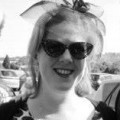
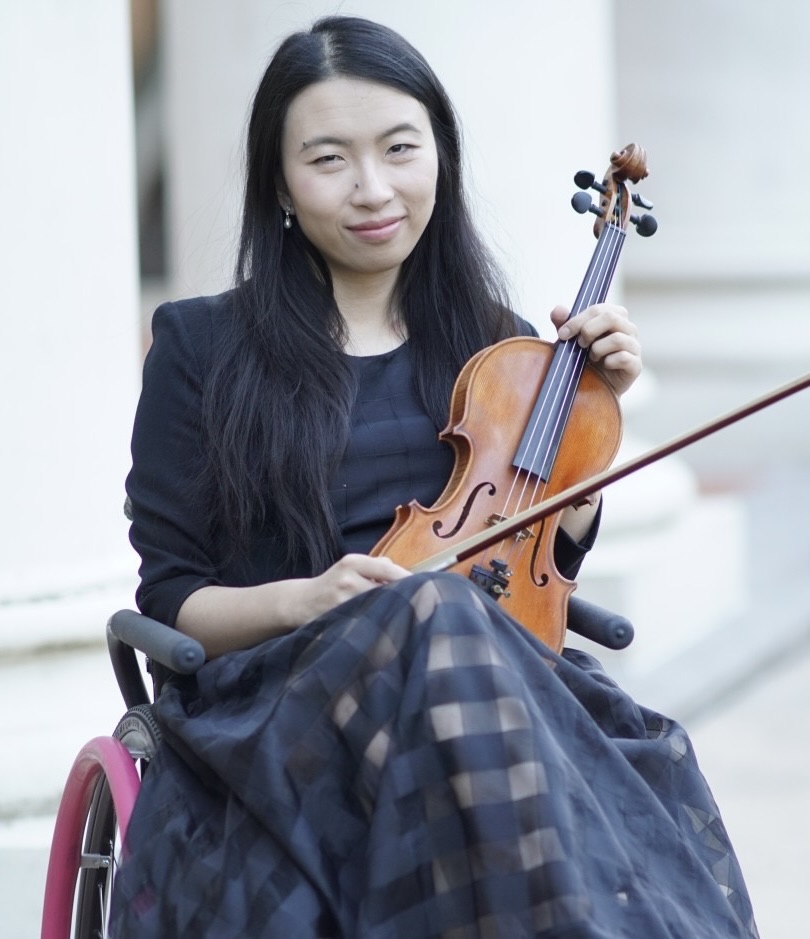
This month, we spoke with Amy Wang-Hiller, a violinist living with quadriplegia, hypermobile Ehlers-Danlos syndrome (hEDS), and related complex neuro-connective tissue conditions. As a violin instructor, Amy works with intermediate and advanced musicians navigating changes that affect performance, such as complex neurological disorders. She is also a disability advocate, founder of the InclusiVibe Foundation, and host of The Hidden Diagnoses Impact podcast.
For readers who may not know you, can you tell us a little about yourself and how you first fell in love with the violin?
I started learning violin when I was three and a half years old. At first, it really wasn’t my choice. My parents felt like I should learn something for fun. Violin was also very practical because it was something my parents could carry around easily.
I think what really made me fall in love with it was watching the older students perform. Every year we had recitals, and I would sit there looking at these older kids playing these amazing pieces. I remember thinking, “Oh my God, they’re so good.” I wanted to play like them.
As time went on, violin practice just became part of my life. Even when I was sick as a child with high fevers, the first thing I wanted after feeling even slightly better was to practice. The habit of practicing and the realization of the gap between myself and a professional violinist were the little moments that built my commitment and love for becoming a professional violinist.
Can you walk us through your health journey and when things started to take a turn?
I feel like my health journey was really a long series of things that nobody realized were connected. As a child, I was constantly getting sick with fevers, tonsillitis, vision issues, jaw pain, and later stomach problems. It was always one thing here and one thing there, and nobody was really putting those pieces together.
After moving to the United States in 2012, I was involved in a car accident and later had a fall in 2015. Looking back, those seemed to mark a turning point. I started having unexplained falls, balance problems, difficulty eating, and so many things that just felt “weird.” I use that word because I simply didn’t have the language to describe symptoms that were unfamiliar to me and didn’t fit what clinicians expected. That uncertainty, combined with earlier medical trauma, created a great deal of self-doubt.
In 2020, everything accelerated after a neck hyperextension injury. Over the next two years, I developed severe POTS symptoms, dystonia, drop attacks, fainting, periods of temporary paralysis, and then progressive loss of motor function. As more testing was done, hypermobile Ehlers-Danlos syndrome was finally diagnosed. And other diagnoses, like puzzle pieces, slowly fell into place, like occult tethered cord and craniocervical instability with a severe upper cervical ligament injury. Looking back, I often wonder how much suffering might have been reduced through earlier recognition, stronger communication between specialties, and greater awareness of complex connective tissue disorders.
Many people hear the term quadriplegia and immediately think of complete paralysis of all four limbs. Can you tell us what quadriplegia means in your case and how it affects your life?
When people hear the word quadriplegia, they often imagine someone who cannot move or feel anything at all, but most cases are actually incomplete quadriplegia. As my doctor explained to me, there are different levels of spinal cord injury. Only AIS A is considered complete. I am classified as AIS B, which means sensory incomplete. In practical terms, I have some sensation and very limited movement, but not enough for independent function. I often tell people to imagine their body encased in cement. You know exactly what you want your body to do, but the signals simply aren’t able to easily pass through those injured segments. From the outside, people may see small movements or swings and assume I can do much more than I actually can. In reality, I rely on others for virtually every aspect of daily life, 24/7, from eating, dressing, and showering to getting out into the community. My experience has taught me that paralysis exists on a spectrum, and many people—even healthcare professionals—don’t realize what that can actually look like for each individual.
At various points in your diagnostic journey, some of your symptoms were misattributed to psychological or functional causes. How did those labels impact your care and your relationship with the healthcare system?
The psychological and functional labels didn’t just affect my medical care; they changed the way I saw myself. Years of gaslighting and psychiatric misattributions made me question my own symptoms. At one point, I even believed those psychiatric explanations, repeating them to my family and my audience at one point. That’s one of the greatest harms of misdiagnosis.
In 2022, my relationship with my neurologist broke down when I was referred to a functional neurological disorder clinic. My ability to play the violin was used as ‘evidence’ that my weakness was inconsistent, even though my neurological condition continued to worsen. A similar thing happened again in 2024, when signs of my paralysis were initially interpreted as functional before my dependence on a ventilator changed how my condition was viewed.
Even now, those earlier labels continue to affect my care. Despite multiple psychiatric evaluations and neuropsychological assessments, I still struggle to correct inaccuracies in my medical record. Once those labels are attached to a patient, they can continue to shape how future clinicians interpret new symptoms, and rebuilding that trust can be incredibly difficult.
As a Chinese-born patient and advocate, do you feel there is room for greater cultural and ethnic diversity within the way EDS is represented and discussed?
Connective tissue disorders can affect anyone. As a Chinese-born person with EDS, I believe my spinal manifestations were more difficult to recognize, and I’m sure there are other Asian patients having similar experiences. I have a good friend who is also Asian and lives with EDS and severe respiratory complications that required a tracheostomy. We deserve to be seen and believed. When people only encounter one picture of EDS, patients from different ethnic backgrounds tend to be overlooked or diagnosed much later. I hope more people from different ethnicities with EDS and spinal manifestations will share their experiences so we can broaden the conversation, challenge outdated assumptions, and help more patients feel seen.
Throughout your journey, you’ve worn so many hats: musician, educator, patient, advocate, and now nonprofit founder. What inspired you to create the InclusiVibe Foundation, and what need were you hoping it would fill?
As my health journey became more complex, I realized I wasn’t the only one struggling to have others understand what I was going through. As I listened to more patients, I kept hearing the same themes. Many of us live with complex neuro-connective tissue conditions that don’t fit neatly into one specialty. Patients often move from one specialist to another, left to coordinate their own care while navigating fragmented healthcare systems and providers who may not be familiar with these conditions. I realized this was a gap that very few organizations were trying to address, especially with spinal manifestations. The common thread wasn’t that everyone had the same diagnosis. It was that so many of us were facing the same gaps in understanding and pathways to care.
So, I founded the InclusiVibe Foundation. We’re a community-led organization built on the belief that patients deserve to be heard, and that lived experience should help inform research, education, and care. Through music, storytelling, advocacy, and collaboration, we hope to bring patients, clinicians, researchers, educators, and artists together. If we can build stronger partnerships across disciplines and communities, I believe we can create healthcare systems that are not only more informed, but more compassionate.
You once shared a Chinese saying that “good luck and bad luck create each other.” What would you like readers who may be struggling with their own health challenges to take away from that idea?
There’s a Chinese saying that I often think about: “Fortune and misfortune are interdependent” (福祸相依, fú huò xiāng yī). It doesn’t mean suffering is good or that everything happens for a reason. It means we often can’t see the whole story while we’re living it.
When I look back at my own journey, I see years of loss, uncertainty, and experiences I would never wish on anyone. At the time, I couldn’t imagine that anything good could come from them. But over time, unexpected things emerged. My relationship with my parents grew stronger. I found a new purpose through education, advocacy, writing, and eventually founding the InclusiVibe Foundation.
That doesn’t erase the pain, and it doesn’t mean I would choose this journey again. But both can be true at the same time.
If there’s one thing I hope readers take away, it’s that they don’t have to find meaning right away. It’s okay to still be in the middle of a difficult chapter. Healing doesn’t always mean getting better physically. Sometimes it means discovering that your life can still have meaning, connection, creativity, and hope, even if it looks very different from what you imagined.
I don’t know what tomorrow will bring, but I do know that none of us must face those difficult chapters alone. Each of us can take action, using our own strengths and expertise, one day at a time, to help build a more understanding and compassionate world.
To learn more about Amy’s work, read her writing, or share your own story, visit:
- Amy Wang-Hiller: https://www.amywanghiller.com
- InclusiVibe Foundation: https://inclusivibe.org
Jacqueline Teti, Author
Editor-in-Chief &
Director or Programs, CPP
July, 2026