craniocervical instability

Amy Wang-Hiller seated in a wheelchair, holding a violin and bow, wearing a black dress and smiling at the camera.

An Interview with Amy Wang-Hiller: Music, Disability, and Advocacy

This month, we spoke with Amy Wang-Hiller, a violinist living with quadriplegia, hypermobile Ehlers-Danlos syndrome (hEDS), and related complex neuro-connective tissue conditions. As a violin instructor, Amy works with intermediate and advanced musicians navigating changes that affect performance, such as complex neurological disorders. She is also a disability advocate, founder of the InclusiVibe Foundation, and […]

Soft sketch-style illustration of an upright MRI machine with a dark-haired patient seated inside wearing MRI-safe clothing. A female MRI technologist stands beside the machine, speaking with the patient and adjusting the controls. The image depicts a weight-bearing upright MRI in a calm clinical setting.

Seeing the Spine in Motion: Exploring the Potential Benefits of Upright MRI in EDS

This article explores whether upright MRI may be a useful tool for evaluating EDS-related spinal instability. Understanding the limitations of standard MRI and what positional imaging could offer instead, may help patients, clinicians, researchers, advocates, and healthcare providers better navigate the complex neurosurgical landscape of EDS.   Why Supine MRI May Miss the Problem Cervical […]

mri images of the brain

Measuring the Unmeasured

What Two New Studies Say About the Head, Neck, and hEDS People with Ehlers-Danlos syndrome have heard for years that their symptoms are “in their head.” In one sense, that may be true—but not in the way we all hate to hear. When it comes to symptoms like headaches, nausea, dizziness, brain fog, visual disturbances, […]

A woman with brown hair in a bun from behind with an illustration of the spine along her spine.

New CCI Research: Understanding the Frequency of Neurosurgical Interventions in Connective Tissue Disorders

A recent study conducted by Ruhoy et al. investigates the frequency of comorbidities and the need for neurosurgical interventions in individuals with connective tissue disorders (CTDs), offering valuable insights into the multifaceted challenges faced by this patient population. What’s the study about? CTDs are a diverse group of disorders that impact connective tissue, leading to […]

A set of different surgical tools

Outcomes of Craniocervical Instability Fusion Surgery in People with EDS

A recent study by Henderson et al. found significant benefits for EDS patients with severe craniocervical instability who underwent occipito-cervical fusion surgery.  Craniocervical instability is one of the most severe neurological complications of the Ehlers-Danlos syndromes, causing many affected individuals symptoms such as headaches, severe full body pain, dizziness, nausea, blurred vision, paresthesia, fatigue, weakness, […]
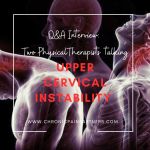
Three illustrations of people bending their neck forwards and back. Text: Q&A Interview: Two Physical Therapists talking Upper Cervical Instability

New Cervical Spine Instability Publication: The Authors Explain Their Findings

For Chronic Pain Partners Newsletter, writer Christie Cox speaks with two pioneers in the Ehlers-Danlos community Leslie Russek and Susan Chalela, about their recent publication on upper cervical instability (UCI). Leslie Russek is a DPT, PhD, and Professor Emeritus of Physical Therapy at Clarkson University and an Orthopedic Certified Specialist Physical Therapist with over 30 […]